
Building and Decorative Stone Collection of the NHM Vienna awarded
16. July 2026
The building and decorative stone collection of the Natural History Museum Vienna was awarded the title "IGUS Geocollection" and is thus one of the world’s most important earth science collections.
[Translated by eTranslation]
The International Union of Geological Sciences (IUGS) aims to evaluate, network and promote geological, paleontological and mineralogical collections on a global scale. It confers the title "IGUS Geocollection" on the world’s most important earth science collections. Recently, the building and decorative stone collection of the NHM Vienna has been awarded this title.
The Subcommission on Geocollections, a group of 19 international experts led by Univ.-Prof. Mathias Harzhauser, Director of the Geological-Paleontological Department of the Natural History Museum Vienna, is responsible for defining this standard and evaluating the collection.
Earth science collections are archives of Earth's history. At the same time, the collections are often of high cultural and historical value as well as a central means of imparting knowledge. In this case, the building and decorative stone collection represents a special "stone archive" of architectural history and would be honoured internationally for it.
The collection consists mainly of natural stones (formatted and polished on one side), but also contains some artificial products such as stucco marble, brick and roof shingles. The pieces represent the building and decorative stones used in monuments and buildings in Austria and, to a lesser extent, in the rest of the world. The collection was initiated by Felix Karrer (1825–1903), a volunteer (today he would be called a citizen scientist) of the NHM Vienna. The occasion was the donation of a stone catalogue by the Union-Baugesellschaft in 1878 and the implementation of the idea by Eduard Suess (1831–1914), who had wished for a geologically ordered collection of decorative stones. The oldest pieces come from the collection of Ambras Castle near Innsbruck (16th century). The collection is constantly growing, mostly through donations from architects' offices and stonemasons.
The building and decorative rock collection is arranged according to geological rock type classification, location and inventory number. Labels and inventory books contain information about the original quarry, place of use, donor or seller and the year of acquisition. It is unique in its completeness with regard to the rock sources of the former Austro-Hungarian monarchy. Based on this information, the collection is regularly consulted by architects, art historians and restorers. The collection is therefore regarded as a stone database of historical buildings, but also as an instrument for introducing the general public to geology, since the specimens are classified according to their geological origin.
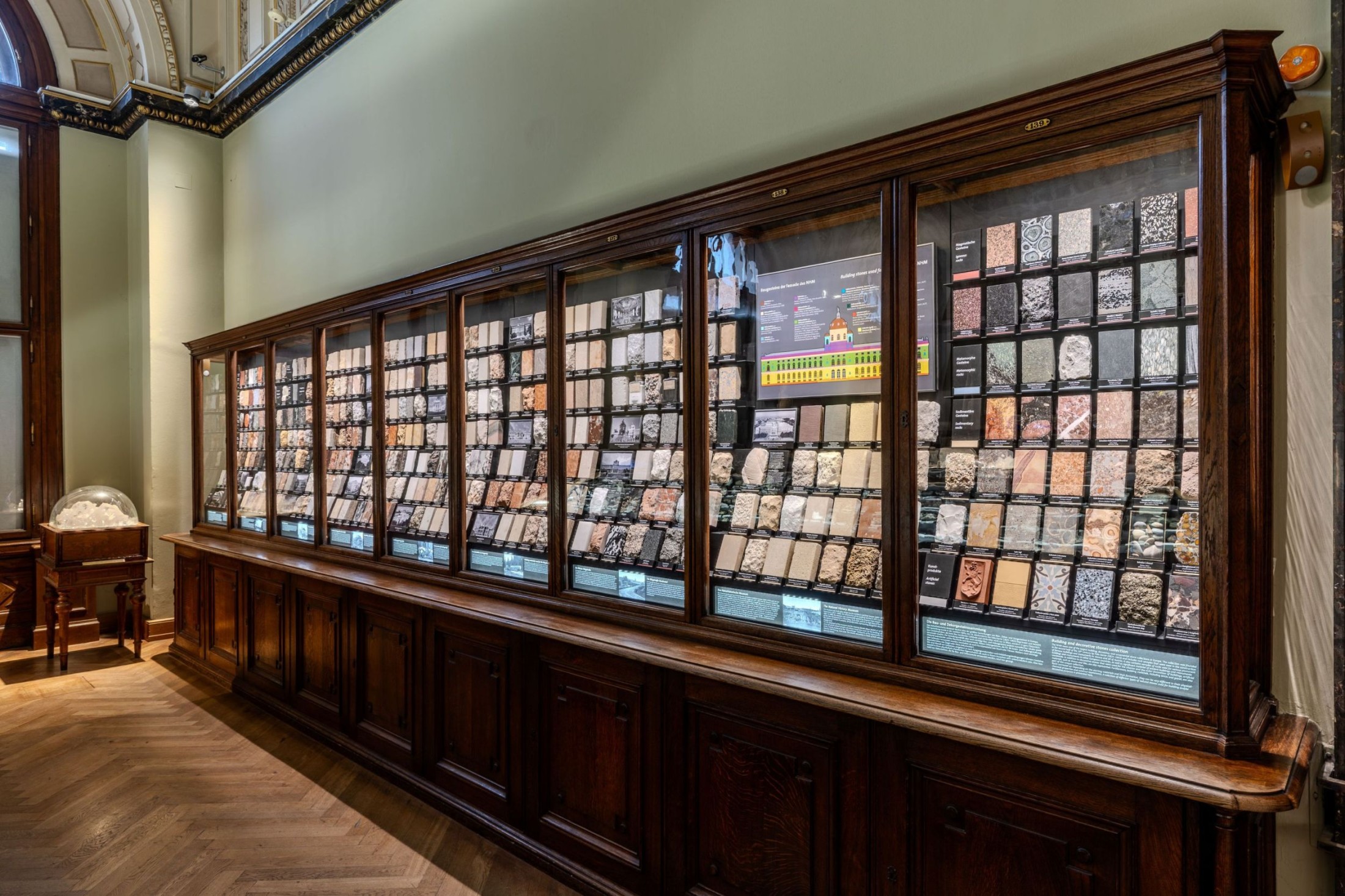
Representative pieces of the building stone collection are exhibited in nine showcases in Hall I of the NHM Vienna. This exhibition was renovated and refurbished in 2015 on the occasion of the 100th anniversary of the opening of Vienna's Ringstrasse.
The collection has been digitised and the Europeana database offers a stage for some selected objects.
The curator of the building and decorative rock collection is Priv.-Doz. Dr. Lidia Pittarello.
TIP: As part of a BÜHNE special tour, 15 guests receive a rare insight into these holdings. Curator Dr. Lidia Pittarello first leads through Hall 1, where representative pieces are exhibited in nine showcases. Afterwards, you will go to the deep reservoir, which is otherwise not accessible to the public, in order to experience selected objects, their origins and their significance as testimonies of historical architecture up close.
Date: Wednesday, 16.09.2026, 6 p.m. in the entrance foyer, Lower Dome Hall
Registration via presse@nhm.at is required.
You can find press fotos here.
Related links:
IGUS Subcommission on Geo-Collections
Scientific inquiry note:
Univ.-Prof. Dr. Mathias Harzhauser
Director of the Geological and Paleontological Department, NHM Vienna
Tel.: +43 (1) 52177-250
mathias.harzhauser@nhm.at
Priv.-Doz. Dr. Lidia Pittarello
Curator of the Petrographic Collection, Research Associate in the Mineralogical-Petrographic Department, NHM Vienna
https://www.nhm.at/lidia__pittarello
Tel.: +43 (1) 52177-270
General request for information:
Mag. Irina Kubadinow
Head of Press & Public Relations, Press Spokesperson, NHM Vienna
Tel.: +43 (1) 521 77-410
irina.kubadinow@nhm.at
Mag. Klara Vakaj
Press Officer, Press Department & Public Relations, NHM Vienna
Tel.: +43 (1) 521 77-626
klara.vakaj@nhm.at
The International Union of Geological Sciences (IUGS) aims to evaluate, network and promote geological, paleontological and mineralogical collections on a global scale. It confers the title "IGUS Geocollection" on the world’s most important earth science collections. Recently, the building and decorative stone collection of the NHM Vienna has been awarded this title.
The Subcommission on Geocollections, a group of 19 international experts led by Univ.-Prof. Mathias Harzhauser, Director of the Geological-Paleontological Department of the Natural History Museum Vienna, is responsible for defining this standard and evaluating the collection.
Earth science collections are archives of Earth's history. At the same time, the collections are often of high cultural and historical value as well as a central means of imparting knowledge. In this case, the building and decorative stone collection represents a special "stone archive" of architectural history and would be honoured internationally for it.
The collection consists mainly of natural stones (formatted and polished on one side), but also contains some artificial products such as stucco marble, brick and roof shingles. The pieces represent the building and decorative stones used in monuments and buildings in Austria and, to a lesser extent, in the rest of the world. The collection was initiated by Felix Karrer (1825–1903), a volunteer (today he would be called a citizen scientist) of the NHM Vienna. The occasion was the donation of a stone catalogue by the Union-Baugesellschaft in 1878 and the implementation of the idea by Eduard Suess (1831–1914), who had wished for a geologically ordered collection of decorative stones. The oldest pieces come from the collection of Ambras Castle near Innsbruck (16th century). The collection is constantly growing, mostly through donations from architects' offices and stonemasons.
The building and decorative rock collection is arranged according to geological rock type classification, location and inventory number. Labels and inventory books contain information about the original quarry, place of use, donor or seller and the year of acquisition. It is unique in its completeness with regard to the rock sources of the former Austro-Hungarian monarchy. Based on this information, the collection is regularly consulted by architects, art historians and restorers. The collection is therefore regarded as a stone database of historical buildings, but also as an instrument for introducing the general public to geology, since the specimens are classified according to their geological origin.
Representative pieces of the building stone collection are exhibited in nine showcases in Hall I of the NHM Vienna. This exhibition was renovated and refurbished in 2015 on the occasion of the 100th anniversary of the opening of Vienna's Ringstrasse.
The collection has been digitised and the Europeana database offers a stage for some selected objects.
The curator of the building and decorative rock collection is Priv.-Doz. Dr. Lidia Pittarello.
TIP: As part of a BÜHNE special tour, 15 guests receive a rare insight into these holdings. Curator Dr. Lidia Pittarello first leads through Hall 1, where representative pieces are exhibited in nine showcases. Afterwards, you will go to the deep reservoir, which is otherwise not accessible to the public, in order to experience selected objects, their origins and their significance as testimonies of historical architecture up close.
Date: Wednesday, 16.09.2026, 6 p.m. in the entrance foyer, Lower Dome Hall
Registration via presse@nhm.at is required.
You can find press fotos here.
Related links:
IGUS Subcommission on Geo-Collections
The Vienna Natural History Museum's collection of building and decorative stones on IGUS
Scientific inquiry note:
Univ.-Prof. Dr. Mathias Harzhauser
Director of the Geological and Paleontological Department, NHM Vienna
Tel.: +43 (1) 52177-250
mathias.harzhauser@nhm.at
Priv.-Doz. Dr. Lidia Pittarello
Curator of the Petrographic Collection, Research Associate in the Mineralogical-Petrographic Department, NHM Vienna
https://www.nhm.at/lidia__pittarello
Tel.: +43 (1) 52177-270
General request for information:
Mag. Irina Kubadinow
Head of Press & Public Relations, Press Spokesperson, NHM Vienna
Tel.: +43 (1) 521 77-410
irina.kubadinow@nhm.at
Mag. Klara Vakaj
Press Officer, Press Department & Public Relations, NHM Vienna
Tel.: +43 (1) 521 77-626
klara.vakaj@nhm.at
Building and Decorative Stone Collection of the NHM Vienna

