
Genomic Data Confirm: Eurasian and American Goshawks Are Distinct Species
30. September 2026
At the Natural History Museum Vienna, a systematic analysis has answered a long-debated taxonomic question: the Eurasian Goshawk (Astur gentilis) and the American Goshawk (Astur atricapillus) are two distinct species.
[Translated by eTranslation]
The study examined genome-wide data – several tens of thousands of genetic markers known as SNPs (single nucleotide polymorphisms) – from more than 50 geographically and taxonomically selected birds. The DNA came predominantly from historical specimens held in natural history collections. This research approach is known as museomics. The analysis surprisingly shows that the Eurasian Goshawk is more closely related to two species from Africa and Madagascar included in the study than to the morphologically and ecologically much more similar American Goshawk. The findings thus confirm and substantially expand previous results based on mitochondrial DNA as well as bioacoustic evidence.
In biological systematics and taxonomy, the biodiversity of our planet is studied and classified. The species occupies a key position in this biological system. It serves as a unit for many other disciplines, such as ecology and conservation biology. Research into species boundaries is therefore highly relevant, even though these boundaries are often fuzzy.
A new study by the Natural History Museum Vienna and BOKU University has now used state-of-the-art genetic methods to demonstrate that the Eurasian Goshawk (Astur gentilis), which is also widespread in Austria with more than 1,000 breeding pairs, and the American Goshawk (Astur atricapillus) should unequivocally be regarded as two distinct species. For the first time, the study uses genome-wide data (so-called SNPs) from historical museum specimens covering the goshawks' entire geographic range, thereby closing a major knowledge gap in the taxonomy of birds of prey.
The new findings confirm and expand on insights obtained in 2019 in another study conducted at the Natural History Museum Vienna, which was based on mitochondrial DNA. Together with bioacoustic analyses by other researchers, these studies played a major role in prompting international expert committees to revise the global species status of goshawks and to divide "the" goshawk into two distinct species.
The question of whether American and Eurasian goshawks should be treated as one species or two has occupied scientists for decades. As early as the first half of the 20th century, the two were sometimes classified separately and sometimes lumped together; ultimately, however, the view that they represented a single species distributed across large parts of the Northern Hemisphere prevailed. In recent years, the old question has been revisited using new methods – and has now been unambiguously answered with data based on several tens of thousands of markers from the entire genome. For this purpose, samples were taken from goshawk specimens at the NHM Vienna and other collections from which DNA was subsequently extracted and analyzed.
This approach, known as museomics, is one of the major research focuses at the NHM Vienna and demonstrates the importance of natural history collections for fundamental research in biology. Without these collections, this study would not have been possible. The researchers sampled not only the two goshawk species mentioned above across the entire Northern Hemisphere, but also, for comparison, two of their closest relatives from Africa and Madagascar. In total, more than 50 taxonomically and geographically selected birds were included in the analysis.
The phylogenomic analysis revealed that the two goshawk lineages, which had previously been treated as a single species and are very similar in appearance and ecology, are not even particularly closely related within the goshawk genus. In fact, despite their many differences, our Eurasian Goshawk is more closely related to the two African species than it is to its North American cousin.
"Our genomic analyses show that the Eurasian and American goshawks represent clearly distinct lineages not only geographically but also genetically", says first author of the study Florian Kunz. "The pronounced genetic divergence that we detected across the entire genome confirms that they are two distinct species – with immediate consequences for taxonomy, conservation, and its legal status."
"How we define species is not merely an academic question", emphasizes Min Chai, who is co-first author of the study together with Kunz. "Species concepts have direct implications for how we document biodiversity, how we protect populations, and which legal instruments apply."
The reclassification affects more than scientific terminology. Red Lists, conservation laws, and other legal frameworks in which the two goshawks are still partly treated as a single species will need to be amended accordingly. For birdwatchers, the split also means that two separate species will have to be studied and documented.
Original publication: Kunz, F., Chai, M., Schwentner, M., Zachos, F. E., Kapun, M., Haring, E., "Goshawk genomics: Genome-wide single nucleotide polymorphisms (SNPs) confirm species status of Astur gentilis and Astur atricapillus" (Zoologica Scripta 2026) DOI: 10.1111/zsc.70083
Press photos you can find here.
General Information
Around 11,000 bird species are currently recognized worldwide, comprising nearly 20,000 subspecies. The bird collection of the NHM Vienna houses approximately 75 percent of all known species. In total, the NHM Vienna holds more than 130,000 bird specimens from all around the world. Since September 29, 2026, the bird exhibition halls 29 and 30 at the Natural History Museum Vienna have been presented in a new light! More than 1,000 bird specimens have been dusted, groomed, and, in some cases, newly mounted. The floors have been renovated, the electrical system renewed, and the historic ceiling paintings and heritage-listed showcases professionally restored.
Scientific contact
Dr. nat. techn. Florian Kunz, MSc
BOKU University, Institute of Wildlife Biology and Game Management
Tel.: +43 1 47654-83220
florian.kunz@boku.ac.at
General press contact
Mag. Irina Kubadinow
Head of Press & Public Relations, Press Spokesperson
Tel.: +43 1 521 77-410
irina.kubadinow@nhm-wien.ac.at
Mag. Klara Vakaj
Press officer
Tel.: +43 1 521 77-626
klara.vakaj@nhm.at
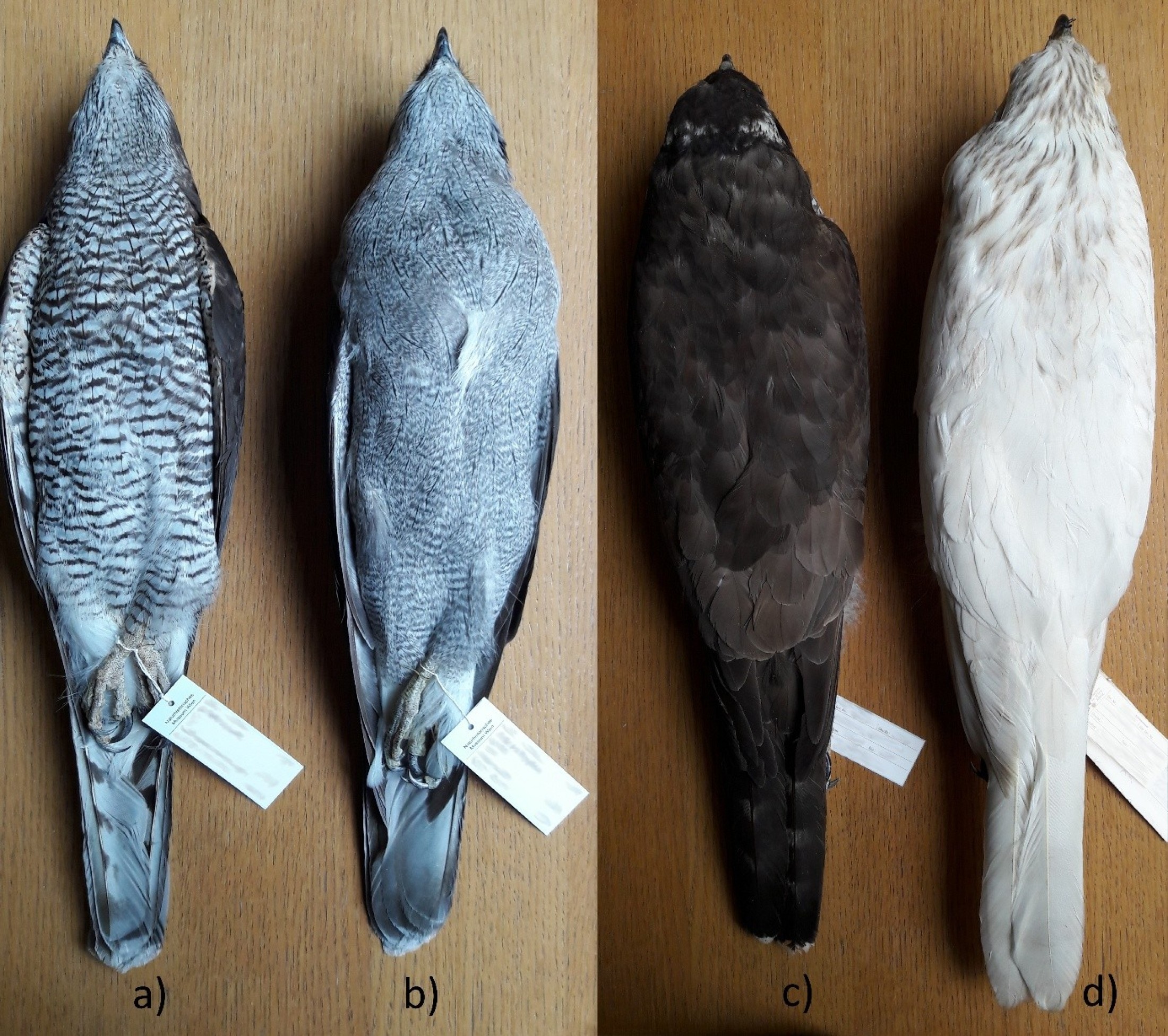
Bälge verschiedener Habichte, wie sie am NHM Wien aus verschiedenen Funden aufgearbeitet und gesammelt werden. Sammlungen solcher Art sind für die Wissenschaft von großem Wert, um verschiedenste Fragestellungen zu beantworten, ohne freilebende Tiere zu beeinträchtigen. Abgebildet sind die Unterseite eines österreichischen (a) und eines nordamerikanischen Habichts (b) sowie die Oberseite eines griechischen (c) und eines sibirischen (d) Habichts. © Florian Kunz
Hochauflösendes Bildmaterial finden Sie hier.
Hochauflösendes Bildmaterial finden Sie hier.

