Press conference on the reopening of the permanent exhibition "Molted! The habitats of birds"
29. September 2026
Bird Halls 29 and 30 at the Natural History Museum Vienna are shining in new splendor!
[Translated by eTranslation]
On Tuesday 29 September 2026
Location: Lecture hall of the NHM Vienna, Maria-Theresien-Platz, 1010 Vienna
Entry: from 10 a.m., start: 10.30 a.m.
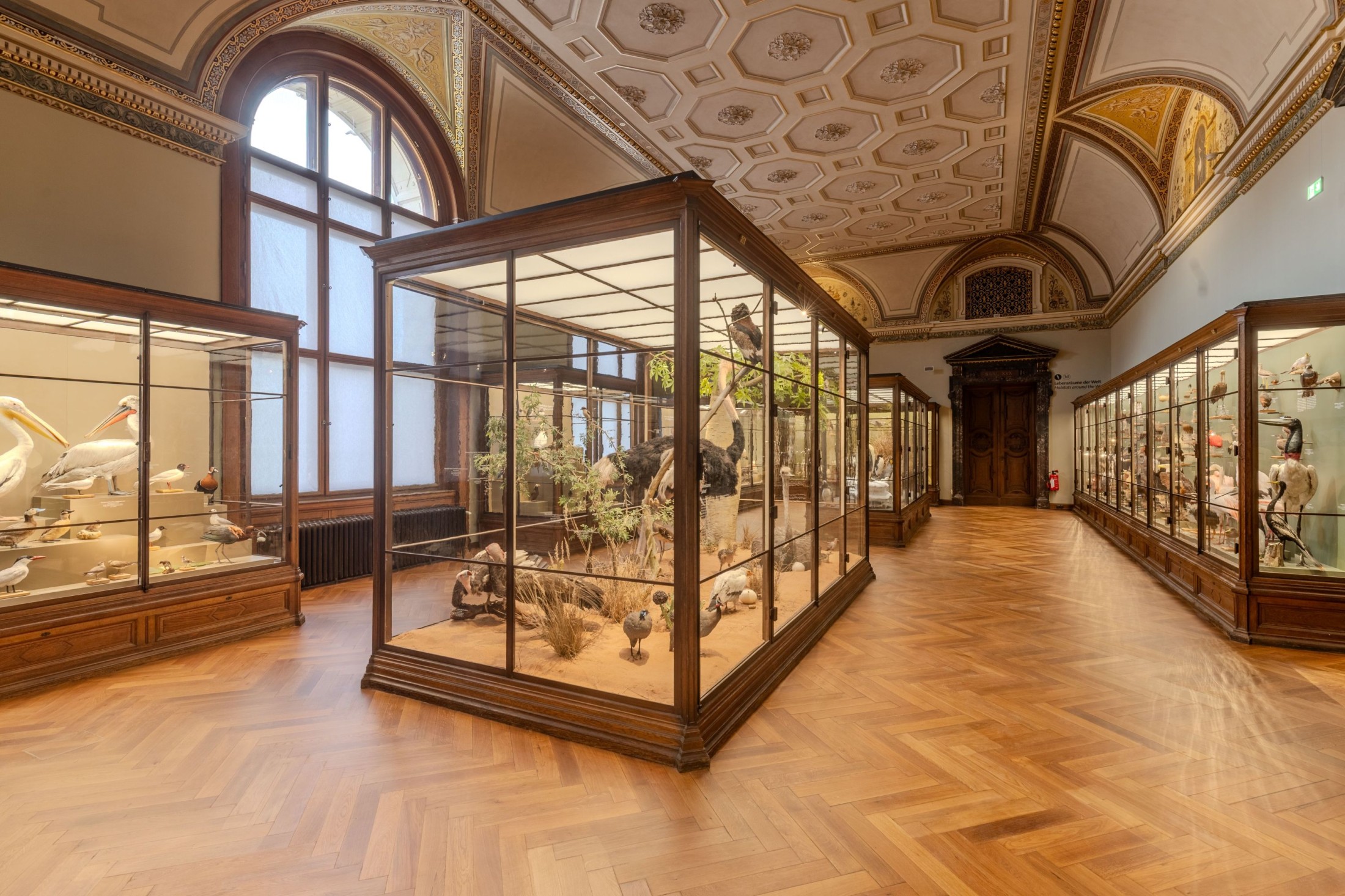
More than 1,000 bird specimens were cleaned, spruced up, and in some cases even re-prepared in the run-up to the opening – a remarkable achievement by the museum's taxidermists. The floors of the exhibition halls were renovated, the electrical systems updated, and the historic ceiling paintings as well as the original showcases were professionally restored.
The halls are dedicated to bird diversity in Central European and global habitats, ranging from the park right outside our door to high mountain ranges and Antarctica. They highlight the unique features and characteristics of both well-known and rare bird species, including their diets and lifestyles, habitat requirements, and roles in a wide variety of ecosystems. The elaborate lighting design was precisely tailored to the exhibits and their habitats.
The new galleries combine aesthetic presentation with substantive depth. The goal is to present birds as a diverse group of animals worthy of protection, whose significance and beauty hopefully will leave a lasting impression on visitors.
Dr. Andreas Hantschk, Department of Science Communication, NHM Vienna
Mag. Dr. Andrea Graser, architect and lighting designer, Studio Okular
Birds have certain things in common: their front limbs have evolved into wings, they all lay eggs and they all have toothless beaks. Birds are warm-blooded animals with a body temperature of around 40 °C. Today around 11,200 bird species are known to science. They are found worldwide and inhabit almost every kind of habitat.
The largest bird living today is the Somali ostrich. It can grow up to 275 cm tall and weigh up to 150 kg. The bee hummingbird is the smallest bird species. It is 5 to 6 cm long and weighs less than 2 g, which is lighter than a single ostrich feather.
Birds are usually easy to observe thanks to their behavior, their calls and songs, and their often striking plumage.
Hall 29 is dedicated to the basic introduction to the world of birds. The focus is on what actually distinguishes birds – from their common characteristics to their evolution and their importance in ecosystems. A special focus is placed on the most important habitats of Central Europe, such as cities, parks or floodplain forests. These are presented in connection with typical bird species, which are often found in these habitats in Austria. The focus is on the characteristics of the individual habitats as well as their ecological interactions with birds.
Hall 30 plays a special role within level 2 of the NHM Vienna. Thanks to its central location and access from three sides, it is ideal for opening up views beyond Central Europe. This room presents the most important habitats in the world – vividly staged, for example in dioramas to the Arctic or to globally important mountain fog forests. In addition to the colourful birds as the main eye-catcher and the impressive diversity of bird species worldwide, it also addresses global challenges, including the spread of deserts, the loss of habitats or the impact of human intervention on biodiversity. The hall thus combines aesthetic presentation with depth of content and invites you to deal with current environmental issues.
Whether feather in the hair, a beak on the face, wings on the back or a homemade bird outfit - there are no limits to the imagination. Those who flutter between 8.00 and 9.00 o'clock and present their personal bird accessory receive free admission and are thus officially one of the early birds of the NHM Vienna.
Notes: From 8 a.m. to 9 a.m., the two new bird halls are exclusively open; from 9 a.m., the entire museum is open for a visit. We would like to inform you that photos will be taken when taking advantage of the discount. These recordings are created for the purpose of public relations and published promptly on our social media channels. If you wish to object to the production of a photograph of them, please contact the photographers.
Wednesday 30 September 2026, 5:00–6:00 p.m.
Andreas Hantschk, Julia Landsiedl, Christof Viehauser (NHM Vienna)
A new highlight among the showrooms on level 2 are the two habitat halls of the birds: A product of successful collaboration between scenography and graphics, science communication and the 1. and zoology. More information can be found here.
The new habitat halls of birds
Wednesday, 04 November 2026, 5:00–6:00 p.m.
Wednesday 18 November 2026, 5:00–6:00 p.m.
Christof Viehauser (1. Zoology, NHM Vienna)
Embark on a journey from the mallard ducks in the Viennese parks to the ostriches of the African Sahel zone. More information can be found here.
Birds in the spotlight
Wednesday 11 November 2026, 5:00–6:00 p.m.
Andreas Hantschk (Science Communication, NHM Vienna), Julia Landsiedl (Exhibition Management, NHM Vienna)
Freshly moulted, effectively illuminated and professionally conveyed – this is how the new habitats of the birds present themselves. More information can be found here.
Wednesday 21 October 2026, 5:00–6:00 p.m.
Christof Viehauser (1. Zoology, NHM Vienna)
The variety of shapes and colours of birds can be seen not only in the showrooms, but especially in the scientific collection. More information can be found here.
Wednesday 30 September 2026, 6:30–8:00 p.m.
Swen Renner (1. Zoology, NHM Vienna)
Where a bird lives determines how it lives – but its habitats are not all natural. Human beings form them. How does our use of forest and meadows change birdlife?
Various bird habitats in Central Europe and worldwide show what research reveals about birds and their endangered habitats. More information can be found here.
Saturday/Sunday, 03/04 October 2026, 11:15–11:45 a.m.
Saturday/Sunday, 10-11 October 2026, 11:15–11:45 a.m.
Saturday/Sunday, 17-18 October 2026, 11:15–11:45 a.m.
Birds are special animals. They meet us every day, even in the middle of the big city. In the mini-meeting, we take a close look at bird preparations and find out what ‘typical bird’ is. View dates
Kids & Co from 6 years: Freshly moulted - The new bird halls
Saturday/Sunday, 03/04 October 2026, 2:00–2:30 p.m.
Saturday/Sunday, 10-11 October 2026, 2:00–2:30 p.m.
Saturday/Sunday, 17-18 October 2026, 2:00–2:30 p.m.
Join us in our two newly opened bird halls and discover birds from all over the world and their habitats. Short guided tour in the exhibition collection and activities for research and self-discovery. View dates
Open Deck: Diverse birds
Saturday/Sunday, 03/04 October 2026, 11:45 a.m.–3:15 p.m.
Saturday/Sunday, 10-11 October 2026, 11:45 a.m.–3:15 p.m.
Saturday/Sunday, 17-18 October 2026, 11:45 a.m.–3:15 p.m.
On Deck 50, visitors can explore bird sounds and acoustic landscapes. There is the possibility of assigning feathers to their birds and looking at them under a microscope. If you want, you can count ducks. View dates
In the longer action tour, we deal with the acoustic diversity in habitats. Birds can be seen not only with the eyes, but also with the ears. Their audible presence or absence can tell us something about the biodiversity of a habitat.
Bookable from 14 October 2026.
Listen to diversity
Guided action for school classes (grades 7–13)
Duration: 80 minutes
Nature opens up to us not only through the eyes, but also through the ears. Biologists use the voices of birds, amphibians, grasshoppers and the like to document biodiversity. In the bird halls, we deal acoustically with different habitats and experience how landscapes change audibly as biodiversity declines.
Feathered and winged
Guided action for school classes (grades 1–8)
Duration: 50 minutes
Birds are almost everywhere and they meet us every day. But what distinguishes a bird? In the bird halls, we learn what "typical bird" is and get to know "everyday" and exotic birds in their habitats.
Press photos can be found here.
Inquiry note
Mag. Irina Kubadinow
Head of Press & Public Relations, Press Spokesperson, NHM Vienna
Tel.: +43 1 521 77-410
irina.kubadinow@nhm.at
Mag. Klara Vakaj
Press Officer, NHM Vienna
Tel.: +43 1 521 77-626
klara.vakaj@nhm.at
On Tuesday 29 September 2026
Location: Lecture hall of the NHM Vienna, Maria-Theresien-Platz, 1010 Vienna
Entry: from 10 a.m., start: 10.30 a.m.
More than 1,000 bird specimens were cleaned, spruced up, and in some cases even re-prepared in the run-up to the opening – a remarkable achievement by the museum's taxidermists. The floors of the exhibition halls were renovated, the electrical systems updated, and the historic ceiling paintings as well as the original showcases were professionally restored.
The halls are dedicated to bird diversity in Central European and global habitats, ranging from the park right outside our door to high mountain ranges and Antarctica. They highlight the unique features and characteristics of both well-known and rare bird species, including their diets and lifestyles, habitat requirements, and roles in a wide variety of ecosystems. The elaborate lighting design was precisely tailored to the exhibits and their habitats.
The new galleries combine aesthetic presentation with substantive depth. The goal is to present birds as a diverse group of animals worthy of protection, whose significance and beauty hopefully will leave a lasting impression on visitors.
Welcome & Introduction
Dr. Katrin Vohland, Director General and Scientific Director, NHM ViennaOn the scientific concept
Priv.-Doz. Dr. Swen Renner, Head of the Bird Collection, NHM ViennaOn the project process
Christof Viehauser, MSc., Collection Manager of the Vogelsammlung, NHM ViennaDr. Andreas Hantschk, Department of Science Communication, NHM Vienna
On the design
Mag. jur. Dipl. Des. Julia Landsiedl, Director Scenography and Graphics, NHM ViennaMag. Dr. Andrea Graser, architect and lighting designer, Studio Okular
On the preparation
Robert Illek, Head of Main Zoological Preparation, NHM ViennaWhat are birds?
All birds have feathers. These developed from the scales of theropods – the group of dinosaurs from which birds are descended. The first groups of birds, some of which still exist today, emerged around 100 million years ago in the Cretaceous period.Birds have certain things in common: their front limbs have evolved into wings, they all lay eggs and they all have toothless beaks. Birds are warm-blooded animals with a body temperature of around 40 °C. Today around 11,200 bird species are known to science. They are found worldwide and inhabit almost every kind of habitat.
The largest bird living today is the Somali ostrich. It can grow up to 275 cm tall and weigh up to 150 kg. The bee hummingbird is the smallest bird species. It is 5 to 6 cm long and weighs less than 2 g, which is lighter than a single ostrich feather.
Birds are usually easy to observe thanks to their behavior, their calls and songs, and their often striking plumage.
On the permanent exhibition
According to the participatory master plan developed at the NHM Vienna, the bird halls have been fundamentally renovated and redesigned in terms of content. The aim was to present the diversity of bird life in a clear and up-to-date manner and to make it accessible to a wide audience.Hall 29 is dedicated to the basic introduction to the world of birds. The focus is on what actually distinguishes birds – from their common characteristics to their evolution and their importance in ecosystems. A special focus is placed on the most important habitats of Central Europe, such as cities, parks or floodplain forests. These are presented in connection with typical bird species, which are often found in these habitats in Austria. The focus is on the characteristics of the individual habitats as well as their ecological interactions with birds.
Hall 30 plays a special role within level 2 of the NHM Vienna. Thanks to its central location and access from three sides, it is ideal for opening up views beyond Central Europe. This room presents the most important habitats in the world – vividly staged, for example in dioramas to the Arctic or to globally important mountain fog forests. In addition to the colourful birds as the main eye-catcher and the impressive diversity of bird species worldwide, it also addresses global challenges, including the spread of deserts, the loss of habitats or the impact of human intervention on biodiversity. The hall thus combines aesthetic presentation with depth of content and invites you to deal with current environmental issues.
The early bird catches the worm: Become an early bird!
Are you an early riser? Do you have feathers? A beak? Or at least a strong affinity for the bird kingdom? Get an early bird ticket! On the opening day, Wednesday, September 30, 2026, from 8 a.m. to 9 a.m., free admission applies to all those who appear with a visible bird accessory.Whether feather in the hair, a beak on the face, wings on the back or a homemade bird outfit - there are no limits to the imagination. Those who flutter between 8.00 and 9.00 o'clock and present their personal bird accessory receive free admission and are thus officially one of the early birds of the NHM Vienna.
Notes: From 8 a.m. to 9 a.m., the two new bird halls are exclusively open; from 9 a.m., the entire museum is open for a visit. We would like to inform you that photos will be taken when taking advantage of the discount. These recordings are created for the purpose of public relations and published promptly on our social media channels. If you wish to object to the production of a photograph of them, please contact the photographers.
Accompanying programme for the exhibition
All events are held in German.Guided tours
The habitats of birds: The Making of an ExhibitionWednesday 30 September 2026, 5:00–6:00 p.m.
Andreas Hantschk, Julia Landsiedl, Christof Viehauser (NHM Vienna)
A new highlight among the showrooms on level 2 are the two habitat halls of the birds: A product of successful collaboration between scenography and graphics, science communication and the 1. and zoology. More information can be found here.
The new habitat halls of birds
Wednesday, 04 November 2026, 5:00–6:00 p.m.
Wednesday 18 November 2026, 5:00–6:00 p.m.
Christof Viehauser (1. Zoology, NHM Vienna)
Embark on a journey from the mallard ducks in the Viennese parks to the ostriches of the African Sahel zone. More information can be found here.
Birds in the spotlight
Wednesday 11 November 2026, 5:00–6:00 p.m.
Andreas Hantschk (Science Communication, NHM Vienna), Julia Landsiedl (Exhibition Management, NHM Vienna)
Freshly moulted, effectively illuminated and professionally conveyed – this is how the new habitats of the birds present themselves. More information can be found here.
Behind the scenes
The scientific bird collection behind the scenesWednesday 21 October 2026, 5:00–6:00 p.m.
Christof Viehauser (1. Zoology, NHM Vienna)
The variety of shapes and colours of birds can be seen not only in the showrooms, but especially in the scientific collection. More information can be found here.
Lecture
Birds between forest and meadow – Bird habitatsWednesday 30 September 2026, 6:30–8:00 p.m.
Swen Renner (1. Zoology, NHM Vienna)
Where a bird lives determines how it lives – but its habitats are not all natural. Human beings form them. How does our use of forest and meadows change birdlife?
Various bird habitats in Central Europe and worldwide show what research reveals about birds and their endangered habitats. More information can be found here.
Family programme
Mini-Meeting from 3 years: Typical birdSaturday/Sunday, 03/04 October 2026, 11:15–11:45 a.m.
Saturday/Sunday, 10-11 October 2026, 11:15–11:45 a.m.
Saturday/Sunday, 17-18 October 2026, 11:15–11:45 a.m.
Birds are special animals. They meet us every day, even in the middle of the big city. In the mini-meeting, we take a close look at bird preparations and find out what ‘typical bird’ is. View dates
Kids & Co from 6 years: Freshly moulted - The new bird halls
Saturday/Sunday, 03/04 October 2026, 2:00–2:30 p.m.
Saturday/Sunday, 10-11 October 2026, 2:00–2:30 p.m.
Saturday/Sunday, 17-18 October 2026, 2:00–2:30 p.m.
Join us in our two newly opened bird halls and discover birds from all over the world and their habitats. Short guided tour in the exhibition collection and activities for research and self-discovery. View dates
Open Deck: Diverse birds
Saturday/Sunday, 03/04 October 2026, 11:45 a.m.–3:15 p.m.
Saturday/Sunday, 10-11 October 2026, 11:45 a.m.–3:15 p.m.
Saturday/Sunday, 17-18 October 2026, 11:45 a.m.–3:15 p.m.
On Deck 50, visitors can explore bird sounds and acoustic landscapes. There is the possibility of assigning feathers to their birds and looking at them under a microscope. If you want, you can count ducks. View dates
Programme for schools
Two new leadership formats focus on the birds. In the 50-minute guided tour, we will explore the fascinating characteristics and abilities of birds based on selected species in European and non-European habitats.In the longer action tour, we deal with the acoustic diversity in habitats. Birds can be seen not only with the eyes, but also with the ears. Their audible presence or absence can tell us something about the biodiversity of a habitat.
Bookable from 14 October 2026.
Listen to diversity
Guided action for school classes (grades 7–13)
Duration: 80 minutes
Nature opens up to us not only through the eyes, but also through the ears. Biologists use the voices of birds, amphibians, grasshoppers and the like to document biodiversity. In the bird halls, we deal acoustically with different habitats and experience how landscapes change audibly as biodiversity declines.
Feathered and winged
Guided action for school classes (grades 1–8)
Duration: 50 minutes
Birds are almost everywhere and they meet us every day. But what distinguishes a bird? In the bird halls, we learn what "typical bird" is and get to know "everyday" and exotic birds in their habitats.
Press photos can be found here.
Inquiry note
Mag. Irina Kubadinow
Head of Press & Public Relations, Press Spokesperson, NHM Vienna
Tel.: +43 1 521 77-410
irina.kubadinow@nhm.at
Mag. Klara Vakaj
Press Officer, NHM Vienna
Tel.: +43 1 521 77-626
klara.vakaj@nhm.at