
respACT-Lab: Why biodiversity is becoming an economic success factor
18. June 2026
At the respACT Lab "Biodiversity in Action" at the Natural History Museum Vienna, representatives from business, science and finance discussed why biodiversity has long since ceased to be a marginal ecological issue, but has become a central risk and opportunity dimension for Austria as a business location.
[Translated by eTranslation]
It became clear that the loss of species and functioning ecosystems has a direct impact on business value creation. Dependencies on natural capital influence production processes, supply chain stability and financing costs. "Biodiversity is one of the big future issues for companies. Those who strategically consider natural capital today strengthen not only their resilience, but also their long-term economic performance and credibility", emphasises Daniela Knieling, Managing Director of respACT.
Katrin Vohland, Director General and Scientific Director of the Natural History Museum Vienna, underlined that biodiversity loss has significant economic consequences: "With the destruction of habitats and their species, we are taking options for the future – be it new food or medicines, or ways of adapting to climate change."
The increasing consideration of nature-related risks in credit and investment decisions was illustrated by Monika Tögel, Sustainability Officer of the Volksbanken-Verbund: "With our Biodiversity Strategy and the brochure 'This is how sustainability works for SMEs and cooperatives', we are providing a clear impetus to integrate biodiversity more into everyday business life. We want to help our customers to better understand the dependencies of their business model on natural capital and to incorporate this knowledge into their decisions."
Successful biodiversity strategies require company-wide approaches that integrate biodiversity into governance structures and strategic decisions. Companies that actively think along with biodiversity are strengthening their future viability in an increasingly complex economic and regulatory environment.
Inquiry note:
respACT - austrian business council for sustainable development
Maximilian Augustin, BA
Tel.: +43 664 197 25 82
m.augustin@respact.at
https://www.respact.at
It became clear that the loss of species and functioning ecosystems has a direct impact on business value creation. Dependencies on natural capital influence production processes, supply chain stability and financing costs. "Biodiversity is one of the big future issues for companies. Those who strategically consider natural capital today strengthen not only their resilience, but also their long-term economic performance and credibility", emphasises Daniela Knieling, Managing Director of respACT.
Katrin Vohland, Director General and Scientific Director of the Natural History Museum Vienna, underlined that biodiversity loss has significant economic consequences: "With the destruction of habitats and their species, we are taking options for the future – be it new food or medicines, or ways of adapting to climate change."
The increasing consideration of nature-related risks in credit and investment decisions was illustrated by Monika Tögel, Sustainability Officer of the Volksbanken-Verbund: "With our Biodiversity Strategy and the brochure 'This is how sustainability works for SMEs and cooperatives', we are providing a clear impetus to integrate biodiversity more into everyday business life. We want to help our customers to better understand the dependencies of their business model on natural capital and to incorporate this knowledge into their decisions."
Successful biodiversity strategies require company-wide approaches that integrate biodiversity into governance structures and strategic decisions. Companies that actively think along with biodiversity are strengthening their future viability in an increasingly complex economic and regulatory environment.
About the format
The respACT-Lab on 17.6.2026 was implemented in cooperation with the Natural History Museum Vienna and the Volksbank as well as with the support of the Federal Ministry of Agriculture, Forestry, Climate and Environmental Protection, Regions and Water Management.About respACT
respACT – austrian business council for sustainable development – is Austria's leading business platform for corporate responsibility, sustainable development and ESG transformation. The association supports more than 450 member companies in the effective and future-oriented implementation of ecological, social and economic goals.Inquiry note:
respACT - austrian business council for sustainable development
Maximilian Augustin, BA
Tel.: +43 664 197 25 82
m.augustin@respact.at
https://www.respact.at
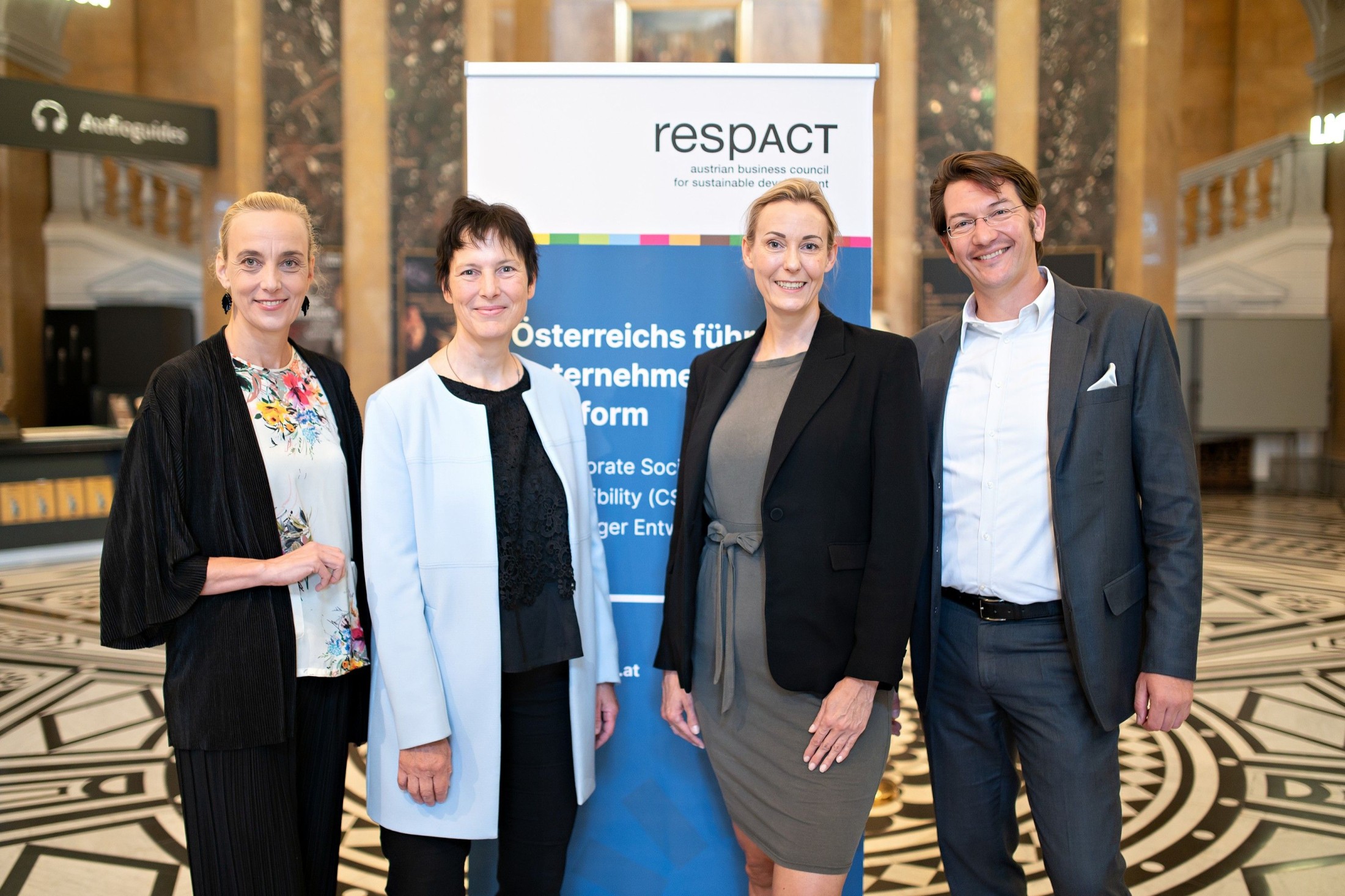
respACT Lab on June 17, 2026, at the NHM Vienna
v.l.n.r.: Daniela Knieling (Geschäftsführerin, respACT), Katrin Vohland (Generaldirektorin & wissenschaftliche Geschäftsführerin, NHM Wien), Monika Tögel (Leitung Stabstelle Nachhaltigkeit Volksbanken-Verbund, Volksbank Wien), Oliver Fiala (Nachhaltigkeitsstrategie, Volksbank Wien)
© respACT/Volksbank Wien, Stefan Seelig
© respACT/Volksbank Wien, Stefan Seelig

