
Kulturpool crosses the 2 million mark
05. November 2025
With impressive 3D digital
copies from the Volkskundemuseum Wien, kulturpool.at has recently made more than two million objects accessible. Already 126
museums, libraries and archives can be found via Austria's central search portal for digitized cultural heritage.
[Translated by eTranslation]
The devil is in the details. But with him, small and large stories await their discovery: Nearly 2,000 digital copies will be available online as 3D models in the Kulturpool as of November 2025: from the reconstruction of a Roman building to an Upper Austrian four-sided farmstead, from the baroque dollhouse to the famous silk Viennese hunting carpet, from the small Austrian groschen to the guardian angel statue – users can enlarge, rotate and admire them at will. What often ends at the shop window glass in the museum becomes possible from home with the click of a mouse. However, the 3D digitization of collection objects and buildings also brings other advantages: It documents the condition of transient materials, thus supporting the restoration of the original and ultimately preserving valuable knowledge for future generations. An example of this is the elaborate reconstruction of the pagan in Petronell-Carnuntum in the course of the EU Commission's Twin-It Action (2023-2024).
New dimensions for Austria's cultural heritage
400,000 new digital copies have arrived in the cultural pool over the summer. These include artistic paintings, historical books, maps and letter correspondences, but also kitchen utensils and fashion from many decades. Since its reconfiguration in March 2024, the search portal and competence centre at the Natural History Museum Vienna has been growing not only in numbers, but also in dimensions:
"The digitisation of objects is picking up speed. In particular, 3D digitisation makes our cultural heritage tangible regardless of place and time," says Doris Wolfslehner, representative of the Ministry of Culture (BMWKMS) and initiator. Currently, 126 museums, archives and libraries from all over Austria are represented in the cultural pool with digitized objects. The 3D objects in the Kulturpool come in addition to the Volkskundemuseum Wien from the Alban Berg Foundation, the Foto- und Kameramuseum WestLicht, the Landessammlungen Niederösterreich, the Mariendom Linz, the Austrian Society for Medieval and Modern Archaeology, the Austrian Archaeological Institute at the Austrian Academy of Sciences (ÖAW) as well as the Stadtmuseum St. Pölten and the Stift Heiligenkreuz.
"I invite all interested parties to be convinced of the diversity of the cultural pool and its partner institutions and to be inspired for their own work or hobby," says Katrin Vohland, Director General of the Natural History Museum Vienna, where the cultural pool is located. A large part of the digitized objects is currently still in preparation and will go online in the coming months. In addition, the cultural pool is also growing due to newly digitized objects from existing partner institutions.
Since its connection to the Kulturpool in July 2025, the Volkskundemuseum Wien has provided around 20,000 digitised objects, photographs, publications and archival material – almost 100 of them in 3D media type. "By integrating our approximately 20,000 digital copies into the cultural pool, the cultural heritage of the Volkskundemuseum Wien becomes part of a larger, open knowledge space. Researchers, teachers and interested parties can access holdings that have not yet been found online and can use them for scientific, creative or journalistic purposes, as well as for school lessons or privately. Together with the Kulturpool, we are thus creating new ways of sharing and developing knowledge," says Matthias Beitl, Director of the Volkskundemuseum Wien.
History of turning, panning and zooming in
A short swing and we are already in the middle of the 18th century. More specifically, in a low, wood-paneled room with two boxes, a wooden table and two chairs. The thick, green window glass obstructs our view to the outside. What kind of panorama can be seen there? One thing is clear: We are located in a cozy Stubbe in the Vorarlberg Montafon. An inscription on the door tells us the year of its completion: 1807. At that time the area belonged to the Kingdom of Bavaria. Who went out and in here every day? The light must have been dim. On the ceiling we see a swivelling candlestick arm. With it you could steer the tallow lamp over the octagonal table or to the stove corner at will. Curiously, we approach the large living room box and look into the open drawer. Two zooms and a few clicks later we left the Stubbe and look directly at the devil's face. Surrounded by colourfully painted wooden figures, all equipped with instruments and props, the carved Belzebub holds a sheet music in one hand and a panflute in the other. The detailed chapel is part of the World Mechanical Theatre (Theatrum mundi) from the collection of the Folklore Museum. And like the Vorarlberg Stubbe, it can be explored and viewed from all sides thanks to 3D digitization. These examples show: 3D models send us on personal journeys to different worlds and times.
Animated worlds
All 2,000 objects in 3D format are available on kulturpool.at – a diverse source that is free and easily accessible. Annotations provide various details about the objects that can be retrieved with a click. Some of the objects are also animated, such as the chess game from the Styrian Salzkammergut from the early 19th century. Once the 3D model is loaded, the storage box opens, the chessboard is opened and the chess pieces float onto the field, each to its position. Now you can look at the 32 wooden figures up close and study every carved detail closely.
The cultural pool in figures (as of: 5 November 2025)
Further information
Explore Austria's digital cultural heritage – Kulturpool
Frequently Asked Questions (FAQ)
sammlung.volkskundemuseum.at
Scientific inquiry note:
Dr. Daniela Apaydin
Project employee "BMKÖS Reconstruction Kulturpool"
https://www.nhm.at/daniela_apaydin
Tel.: +43 664 62 16 193 I daniela.apaydin@nhm.at
General request for information:
Mag. Irina Kubadinow
Head of Press & Public Relations, Press Spokesperson, NHM Vienna
https://www.nhm.at/irina_kubadinow
Tel.: + 43 (1) 521 77-410 I irina.kubadinow@nhm.at
Mag. Klara Vakaj
Press Officer, NHM Vienna
https://www.nhm.at/klara_vakaj
Tel.: +43 (1) 521 77-626 I klara.vakaj@nhm.at
Request information Folklore Museum/Press and Public Relations:
Gesine star
Tel.: +43 (1) 406 89 05-51
Mobile: +43 676 566 85 23
gesine.stern@volkskundemuseum.at
Johanna Amlinger
Tel.: +43 (1) 406 89 05-57
johanna.amlinger@volkskundemuseum.at
The devil is in the details. But with him, small and large stories await their discovery: Nearly 2,000 digital copies will be available online as 3D models in the Kulturpool as of November 2025: from the reconstruction of a Roman building to an Upper Austrian four-sided farmstead, from the baroque dollhouse to the famous silk Viennese hunting carpet, from the small Austrian groschen to the guardian angel statue – users can enlarge, rotate and admire them at will. What often ends at the shop window glass in the museum becomes possible from home with the click of a mouse. However, the 3D digitization of collection objects and buildings also brings other advantages: It documents the condition of transient materials, thus supporting the restoration of the original and ultimately preserving valuable knowledge for future generations. An example of this is the elaborate reconstruction of the pagan in Petronell-Carnuntum in the course of the EU Commission's Twin-It Action (2023-2024).
New dimensions for Austria's cultural heritage
400,000 new digital copies have arrived in the cultural pool over the summer. These include artistic paintings, historical books, maps and letter correspondences, but also kitchen utensils and fashion from many decades. Since its reconfiguration in March 2024, the search portal and competence centre at the Natural History Museum Vienna has been growing not only in numbers, but also in dimensions:
"The digitisation of objects is picking up speed. In particular, 3D digitisation makes our cultural heritage tangible regardless of place and time," says Doris Wolfslehner, representative of the Ministry of Culture (BMWKMS) and initiator. Currently, 126 museums, archives and libraries from all over Austria are represented in the cultural pool with digitized objects. The 3D objects in the Kulturpool come in addition to the Volkskundemuseum Wien from the Alban Berg Foundation, the Foto- und Kameramuseum WestLicht, the Landessammlungen Niederösterreich, the Mariendom Linz, the Austrian Society for Medieval and Modern Archaeology, the Austrian Archaeological Institute at the Austrian Academy of Sciences (ÖAW) as well as the Stadtmuseum St. Pölten and the Stift Heiligenkreuz.
"I invite all interested parties to be convinced of the diversity of the cultural pool and its partner institutions and to be inspired for their own work or hobby," says Katrin Vohland, Director General of the Natural History Museum Vienna, where the cultural pool is located. A large part of the digitized objects is currently still in preparation and will go online in the coming months. In addition, the cultural pool is also growing due to newly digitized objects from existing partner institutions.
Since its connection to the Kulturpool in July 2025, the Volkskundemuseum Wien has provided around 20,000 digitised objects, photographs, publications and archival material – almost 100 of them in 3D media type. "By integrating our approximately 20,000 digital copies into the cultural pool, the cultural heritage of the Volkskundemuseum Wien becomes part of a larger, open knowledge space. Researchers, teachers and interested parties can access holdings that have not yet been found online and can use them for scientific, creative or journalistic purposes, as well as for school lessons or privately. Together with the Kulturpool, we are thus creating new ways of sharing and developing knowledge," says Matthias Beitl, Director of the Volkskundemuseum Wien.
History of turning, panning and zooming in
A short swing and we are already in the middle of the 18th century. More specifically, in a low, wood-paneled room with two boxes, a wooden table and two chairs. The thick, green window glass obstructs our view to the outside. What kind of panorama can be seen there? One thing is clear: We are located in a cozy Stubbe in the Vorarlberg Montafon. An inscription on the door tells us the year of its completion: 1807. At that time the area belonged to the Kingdom of Bavaria. Who went out and in here every day? The light must have been dim. On the ceiling we see a swivelling candlestick arm. With it you could steer the tallow lamp over the octagonal table or to the stove corner at will. Curiously, we approach the large living room box and look into the open drawer. Two zooms and a few clicks later we left the Stubbe and look directly at the devil's face. Surrounded by colourfully painted wooden figures, all equipped with instruments and props, the carved Belzebub holds a sheet music in one hand and a panflute in the other. The detailed chapel is part of the World Mechanical Theatre (Theatrum mundi) from the collection of the Folklore Museum. And like the Vorarlberg Stubbe, it can be explored and viewed from all sides thanks to 3D digitization. These examples show: 3D models send us on personal journeys to different worlds and times.
Animated worlds
All 2,000 objects in 3D format are available on kulturpool.at – a diverse source that is free and easily accessible. Annotations provide various details about the objects that can be retrieved with a click. Some of the objects are also animated, such as the chess game from the Styrian Salzkammergut from the early 19th century. Once the 3D model is loaded, the storage box opens, the chessboard is opened and the chess pieces float onto the field, each to its position. Now you can look at the 32 wooden figures up close and study every carved detail closely.
The cultural pool in figures (as of: 5 November 2025)
- 2,173,863 objects – from prehistory to today – digitally available on kulturpool.at
- of which approx. 2,000 in 3D format
- 126 partner institutions throughout Austria
- 50 editorial articles about the collections and their highlights
- around a quarter of all properties are available under the open licences "Public Domain" and "CC0" and can easily be reused
- 800 results for Gustav Klimt alone, "Klimt" is one of the most popular search terms
Further information
Explore Austria's digital cultural heritage – Kulturpool
Frequently Asked Questions (FAQ)
sammlung.volkskundemuseum.at
Scientific inquiry note:
Dr. Daniela Apaydin
Project employee "BMKÖS Reconstruction Kulturpool"
https://www.nhm.at/daniela_apaydin
Tel.: +43 664 62 16 193 I daniela.apaydin@nhm.at
General request for information:
Mag. Irina Kubadinow
Head of Press & Public Relations, Press Spokesperson, NHM Vienna
https://www.nhm.at/irina_kubadinow
Tel.: + 43 (1) 521 77-410 I irina.kubadinow@nhm.at
Mag. Klara Vakaj
Press Officer, NHM Vienna
https://www.nhm.at/klara_vakaj
Tel.: +43 (1) 521 77-626 I klara.vakaj@nhm.at
Request information Folklore Museum/Press and Public Relations:
Gesine star
Tel.: +43 (1) 406 89 05-51
Mobile: +43 676 566 85 23
gesine.stern@volkskundemuseum.at
Johanna Amlinger
Tel.: +43 (1) 406 89 05-57
johanna.amlinger@volkskundemuseum.at
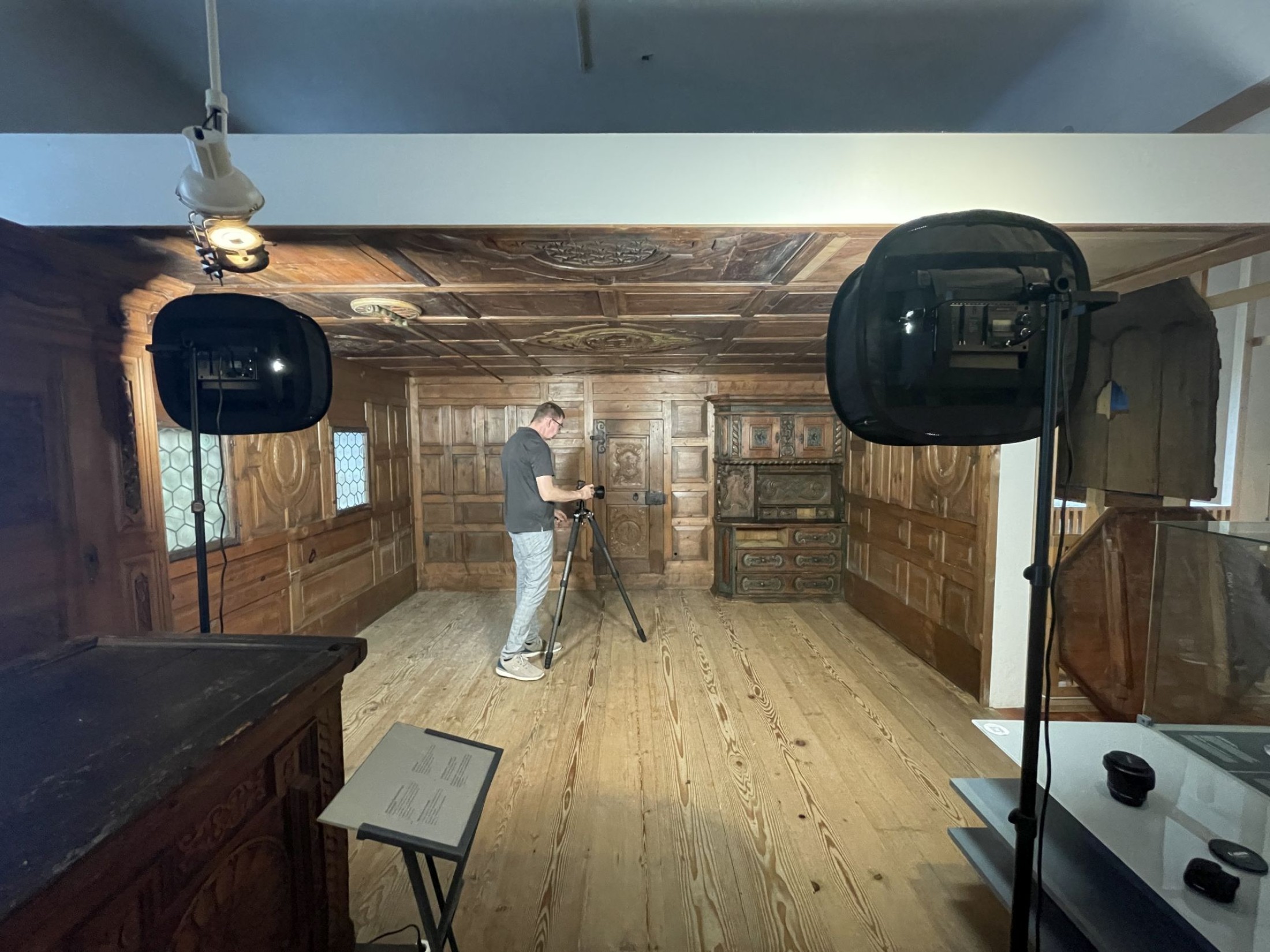
Home Story around 1800
The
paneling and furnishings of the historic Montafon room have been digitally documented by the Vienna Museum of Folk Life and
Folk Art. The making-of process can be viewed here.
© Volkskundemuseum Wien,
Carina Neischl
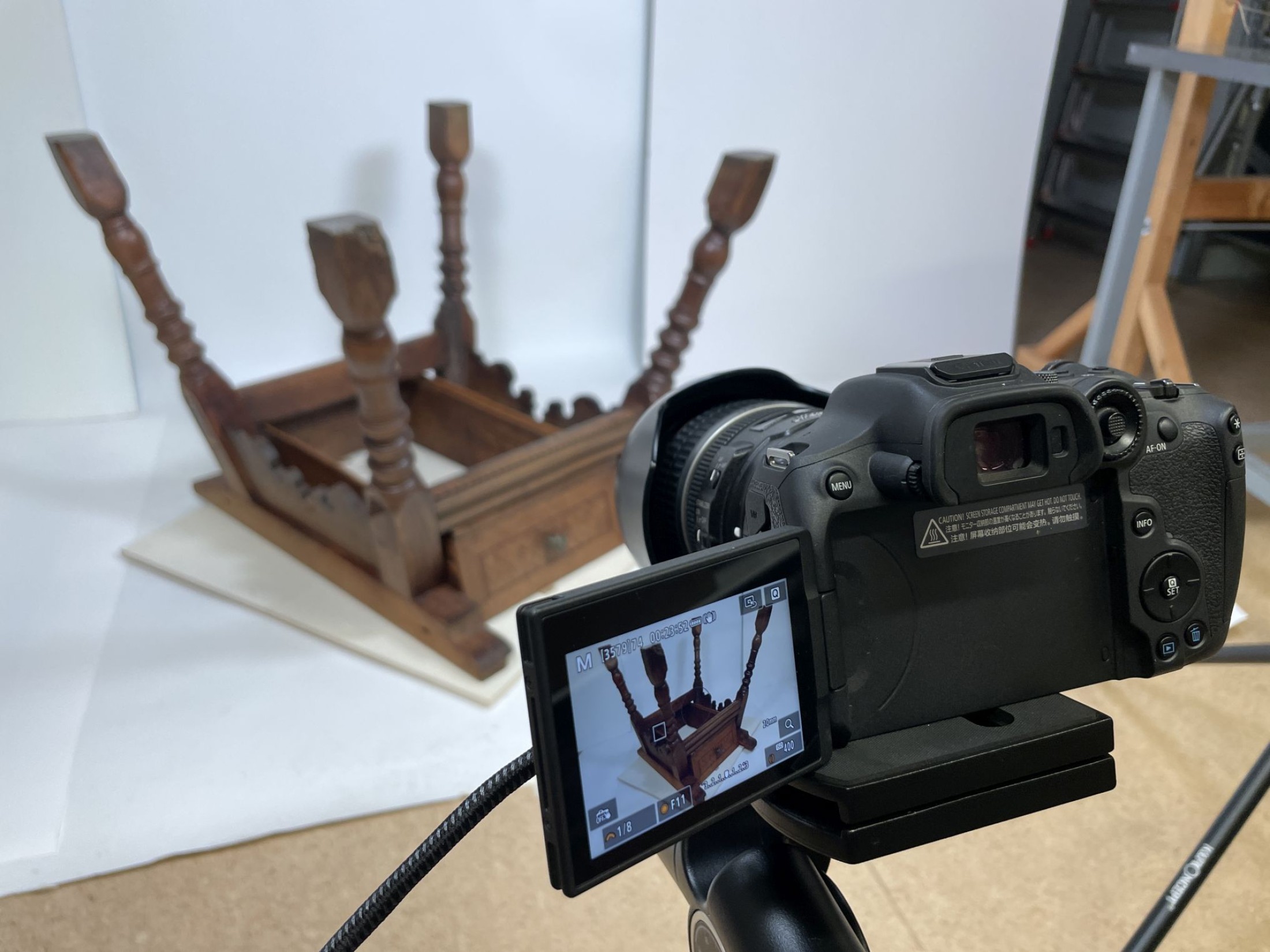
Culture for the Children of Future Generations
3D digitization helps preserve cultural heritage in accurate detail for the long term. Here, a table from an Upper Inn Valley
room was documented by the Vienna Museum of Folk Life and Folk Art.
© Volkskundemuseum
Wien, Carina Neischl
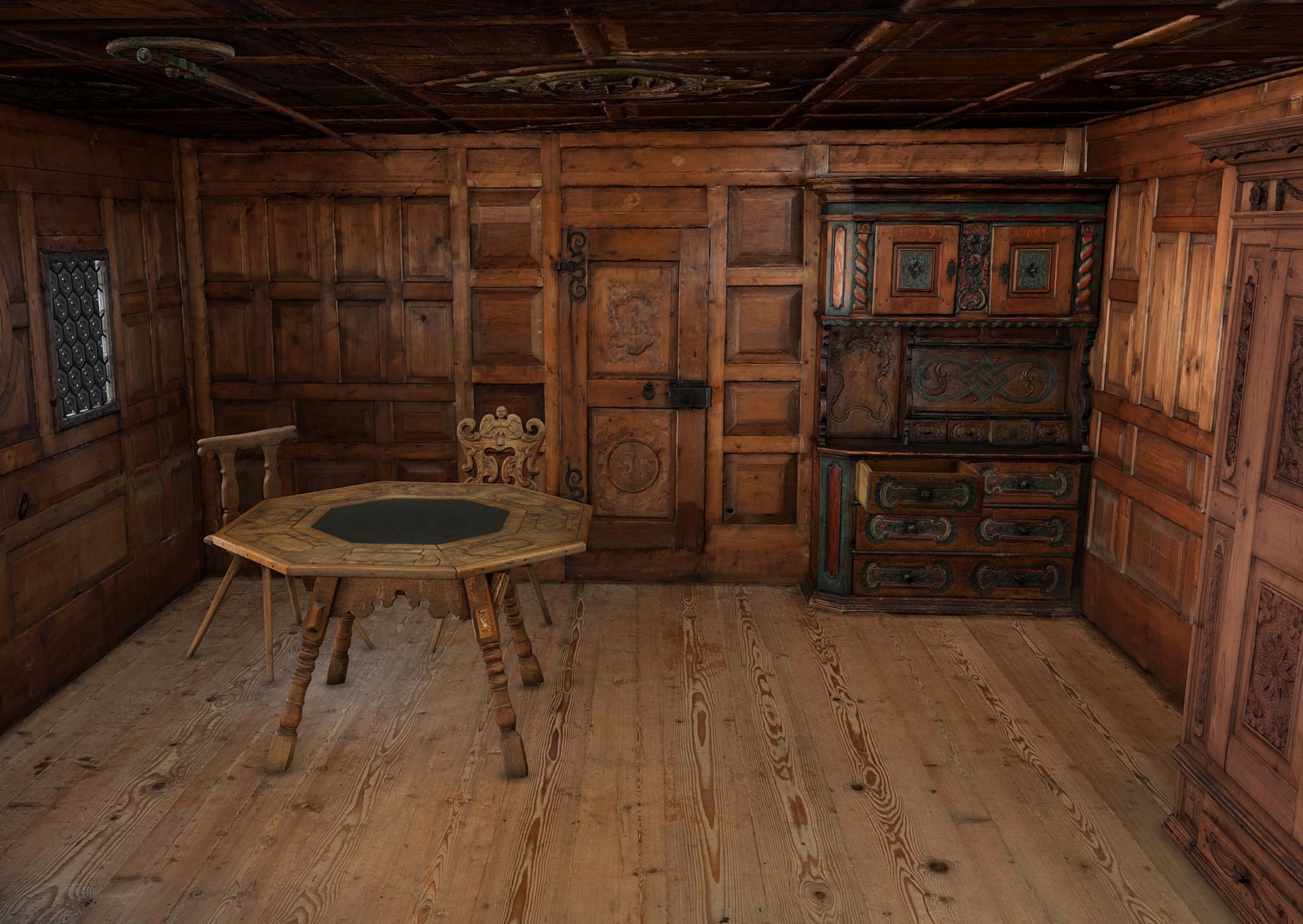
Montafon Room (Screenshot)
Cultural
history in 3D: Thanks to 3D scanning, visitors can explore a Montafon room in detail.
© Volkskundemuseum Wien, Kulturpool
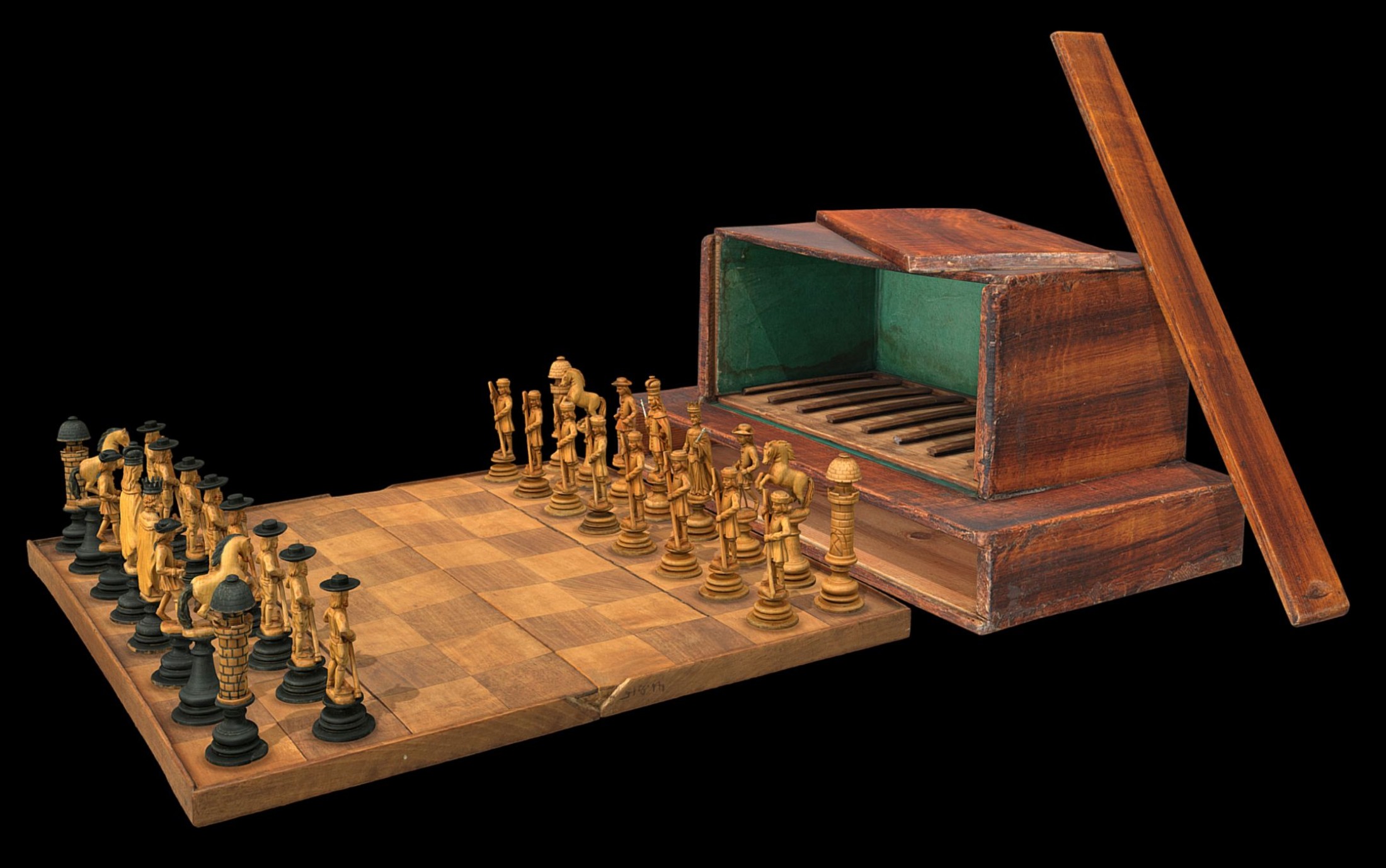
Chessboard
Screenshot of
the 3D object "Chess set with wooden pieces and storage box" (early 19th century)
© Volkskundemuseum Wien, CC BY.
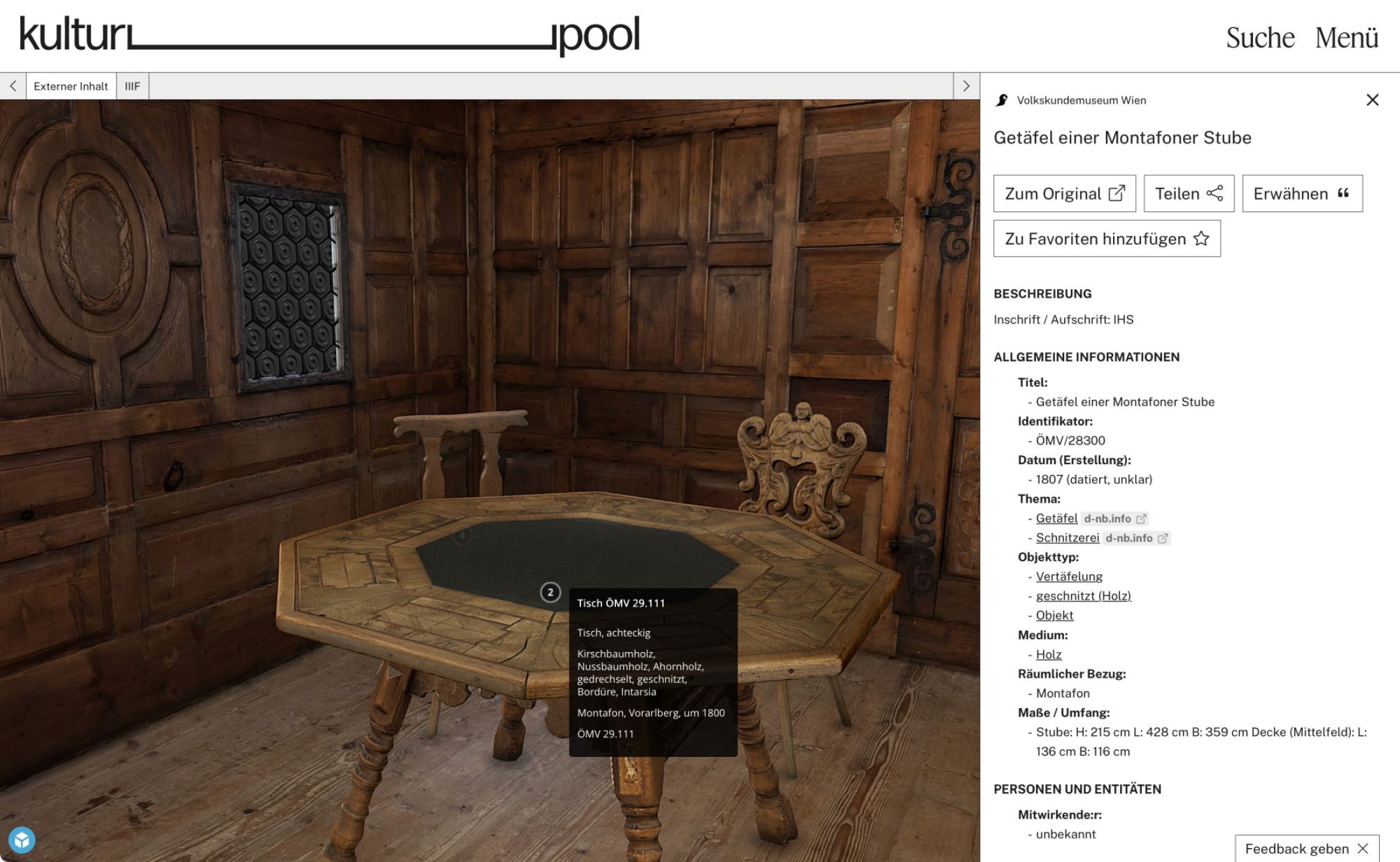
Montafon Room (Full View)
Objects can be annotated with precise, detailed information.
© Volkskundemuseum
Wien, Kulturpool
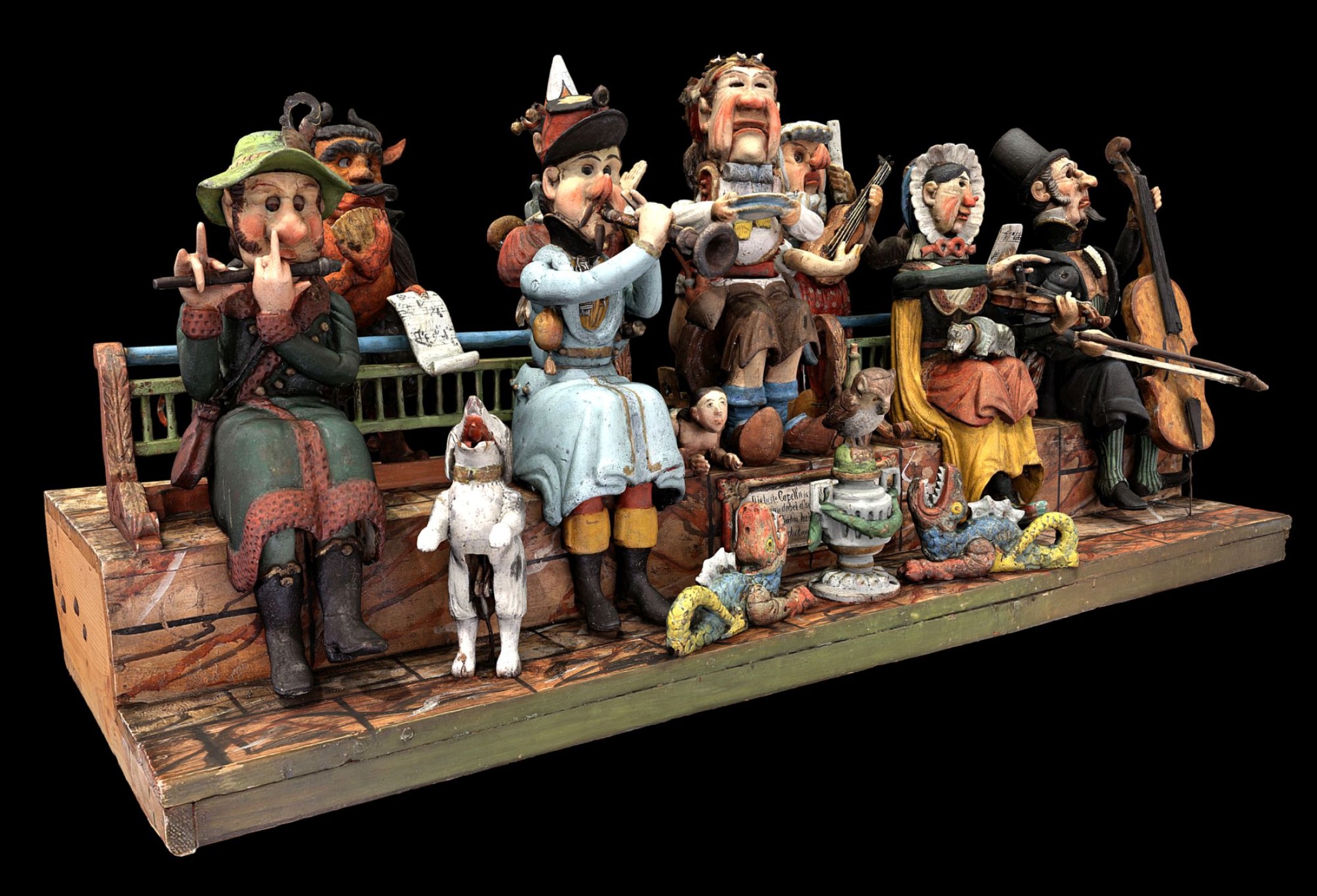
Mechanical World Theater
Screenshot of the 3D object "Mechanical World Theater" (mid-19th century)
© Volkskundemuseum Wien, CC BY.

