
New Moa showcase in the Natural History Museum Vienna
05. February 2026
From now on, a new Moa showcase
in a modern design and with a new arrangement of three Moa skeletons will be on display at NHM Vienna. It is located on level
1, in the so-called "Moa corridor".
[Translated by eTranslation]
Moas were flightless ratites that lived exclusively on New Zealand. They are the only ratites without remnants of wings. Already in the middle of the 15th century, shortly after the settlement of New Zealand, they were exterminated by hunting and clearing. There were nine different species of Moa. In each species, the females became almost twice as large as the males. The largest females weighed probably over 200 kilograms and could stretch their heads up to 3.60 meters. This was not their natural posture. Moas lived in dense forests and ate fruits, leaves and buds. Therefore, they moved through the undergrowth, with their heads in front of their bodies.
Moa skeletons in the new Moa showcase:
The NHM Vienna holds one of the largest collections of these extraordinary ratites outside New Zealand. The paleontological collection holds a total of ten historical skeletal montages of various Moa species as well as several hundred individual bones of different species, all of which are available for scientific research.
The skeletons arrived in the second half of the 19th century between 1862 and 1884 at the k. and k. Hofmuseum in Vienna, today's NHM Vienna. However, they did not arrive as finished skeletons, but as individual parts packed in boxes, which were then assembled by the local paleontologists and preparers at the k. and k. Hofmuseum.
The first four Moa skeletons that arrived in Vienna were presented at the Vienna World's Fair at the New Zealand Show in 1873. They were a crowd-puller, because the world had never seen anything like this before.
Especially impressive was a giant moa (Dinornis robustus), whose skeleton is over 3 meters high. This giant moa, a female as we know it today, had been sent to Vienna for the World's Fair along with the other skeletons of Julius Haast, then director of the Canterbury Museum in New Zealand. After its completion, Haast donated the three Moa skeletons and three additional skeletons in succession to the k. and k. Hofmuseum, for which he was knighted in 1875 by Emperor Franz Joseph I. Other Moa skeletons were purchased by the k. and k. Hofmuseum in 1884 from the New Zealand Canterbury Museum.
Since then, the skeleton of the giant moas and the skeletons of some other Moa species have been on display in various exhibition rooms of the NHM Vienna, most recently in Room 30 of the ornithological exhibition. Other skeletons were in the former ice age of the paleontological exhibition. The redesign of the bird halls now necessitated an in-house relocation of some of the skeletons.
On this occasion, the Geological and Paleontological Department also made some anatomical corrections to the skeletons – a few bones had probably been swapped at the initial assembly. In addition, the skeleton of the giant moa female has been scanned and is now also available digitally. (Further 3D scans of NHM Vienna objects can be found on sketchfab.com.)
Inquiry note:
Mag. Irina Kubadinow
Head of Press & Public Relations, press spokesperson
Tel.: + 43 (1) 521 77-410
irina.kubadinow@nhm.at
Mag. Klara Vakaj
Press officer
Tel.: + 43 (1) 521 77-626
klara.vakaj@nhm.at
Moas were flightless ratites that lived exclusively on New Zealand. They are the only ratites without remnants of wings. Already in the middle of the 15th century, shortly after the settlement of New Zealand, they were exterminated by hunting and clearing. There were nine different species of Moa. In each species, the females became almost twice as large as the males. The largest females weighed probably over 200 kilograms and could stretch their heads up to 3.60 meters. This was not their natural posture. Moas lived in dense forests and ate fruits, leaves and buds. Therefore, they moved through the undergrowth, with their heads in front of their bodies.
Moa skeletons in the new Moa showcase:
- Skeleton on the left: Female of the giant moss Dinornis robustus. It was already exhibited at the World's Fair in Vienna in 1873 and was transferred to the collection of the k. and k. Hofmuseum in 1874.
- Skeleton center: "Dickbeiniger Moa", Euryapteryx curtus gravis, was added to the paleontological collection of the k. and k. Hofmuseum in 1884.
- Skeleton on the right: Males of the giant moss Dinornis robustus, came in 1884 in the paleontological collection of the k. and k. Hofmuseum.
The NHM Vienna holds one of the largest collections of these extraordinary ratites outside New Zealand. The paleontological collection holds a total of ten historical skeletal montages of various Moa species as well as several hundred individual bones of different species, all of which are available for scientific research.
The skeletons arrived in the second half of the 19th century between 1862 and 1884 at the k. and k. Hofmuseum in Vienna, today's NHM Vienna. However, they did not arrive as finished skeletons, but as individual parts packed in boxes, which were then assembled by the local paleontologists and preparers at the k. and k. Hofmuseum.
The first four Moa skeletons that arrived in Vienna were presented at the Vienna World's Fair at the New Zealand Show in 1873. They were a crowd-puller, because the world had never seen anything like this before.
Especially impressive was a giant moa (Dinornis robustus), whose skeleton is over 3 meters high. This giant moa, a female as we know it today, had been sent to Vienna for the World's Fair along with the other skeletons of Julius Haast, then director of the Canterbury Museum in New Zealand. After its completion, Haast donated the three Moa skeletons and three additional skeletons in succession to the k. and k. Hofmuseum, for which he was knighted in 1875 by Emperor Franz Joseph I. Other Moa skeletons were purchased by the k. and k. Hofmuseum in 1884 from the New Zealand Canterbury Museum.
Since then, the skeleton of the giant moas and the skeletons of some other Moa species have been on display in various exhibition rooms of the NHM Vienna, most recently in Room 30 of the ornithological exhibition. Other skeletons were in the former ice age of the paleontological exhibition. The redesign of the bird halls now necessitated an in-house relocation of some of the skeletons.
On this occasion, the Geological and Paleontological Department also made some anatomical corrections to the skeletons – a few bones had probably been swapped at the initial assembly. In addition, the skeleton of the giant moa female has been scanned and is now also available digitally. (Further 3D scans of NHM Vienna objects can be found on sketchfab.com.)
Inquiry note:
Mag. Irina Kubadinow
Head of Press & Public Relations, press spokesperson
Tel.: + 43 (1) 521 77-410
irina.kubadinow@nhm.at
Mag. Klara Vakaj
Press officer
Tel.: + 43 (1) 521 77-626
klara.vakaj@nhm.at
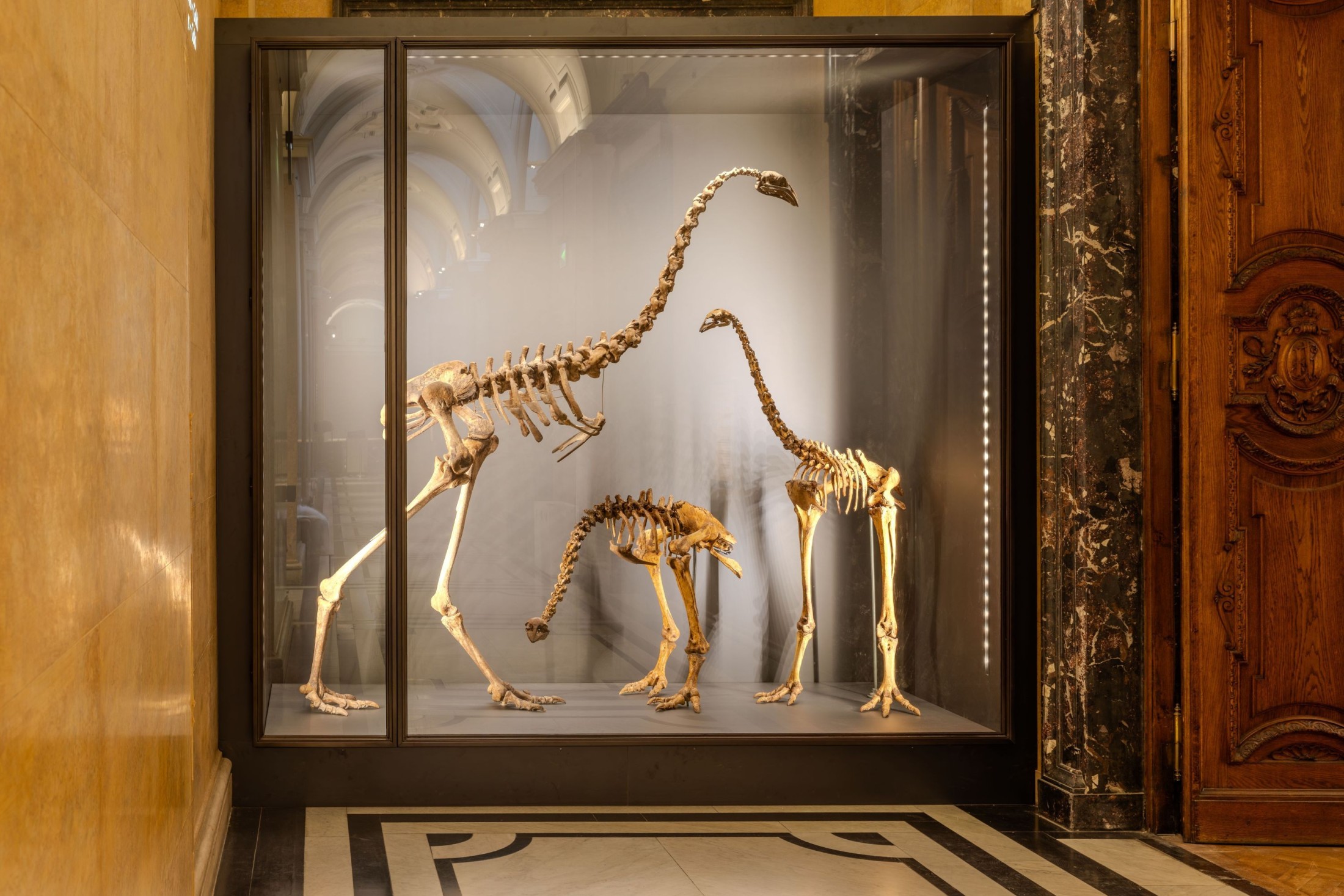
Moa skeletons in the new Moa showcase
Skelett links: Weibchen des Riesenmoas Dinornis robustus
Skelett Mitte: "Dickbeiniger Moa", Euryapteryx curtus gravis
Skelett rechts: Männchen des Riesenmoas Dinornis robustus
© NHM Wien, Wilhelm Bauer-Thell
Skelett Mitte: "Dickbeiniger Moa", Euryapteryx curtus gravis
Skelett rechts: Männchen des Riesenmoas Dinornis robustus
© NHM Wien, Wilhelm Bauer-Thell
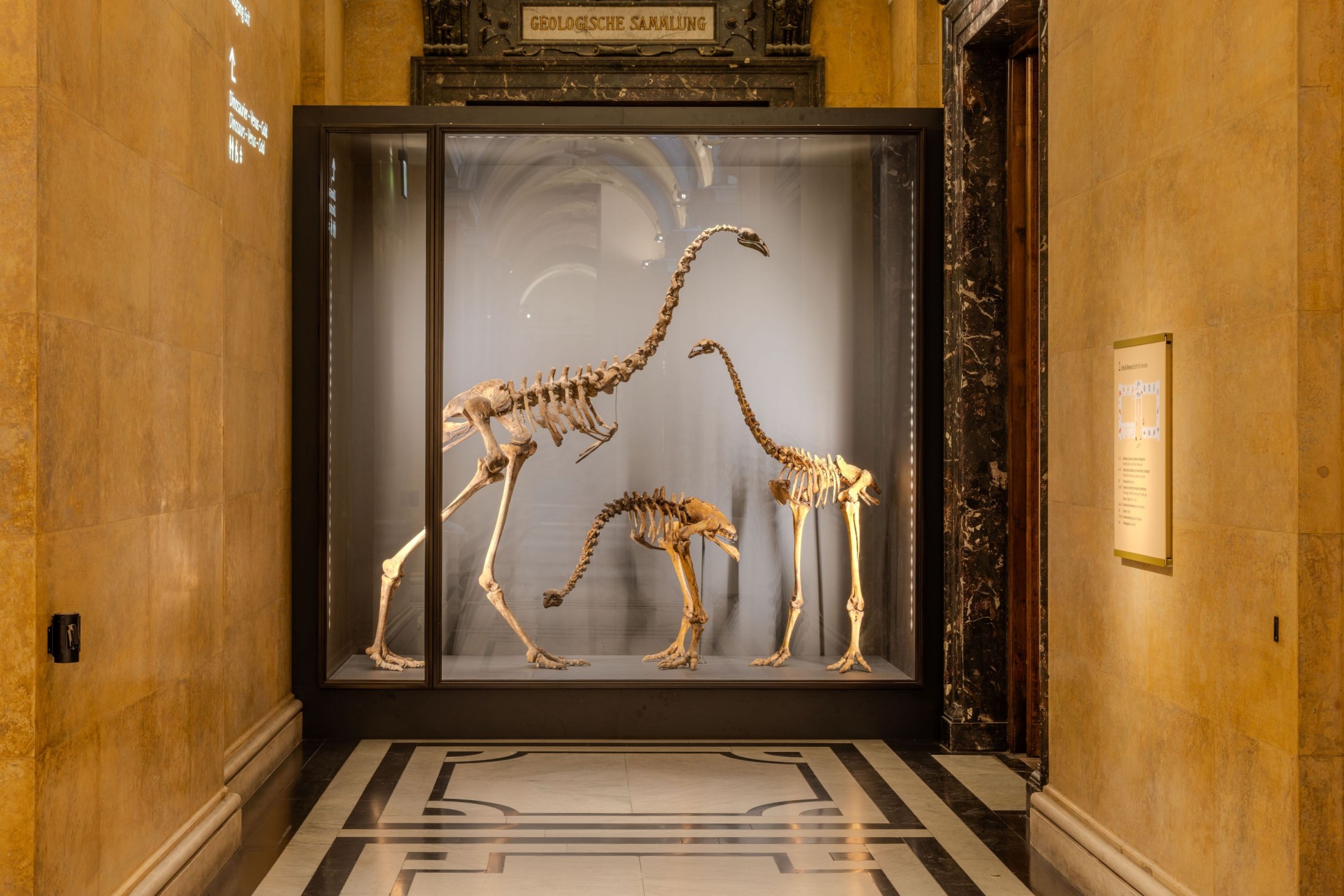
Moa skeletons in the new Moa showcase
Skelett links: Weibchen des Riesenmoas Dinornis robustus
Skelett Mitte: "Dickbeiniger Moa", Euryapteryx curtus gravis
Skelett rechts: Männchen des Riesenmoas Dinornis robustus
© NHM Wien, Wilhelm Bauer-Thell
Skelett Mitte: "Dickbeiniger Moa", Euryapteryx curtus gravis
Skelett rechts: Männchen des Riesenmoas Dinornis robustus
© NHM Wien, Wilhelm Bauer-Thell

