
New Zealand museum pioneer opens Kulturpool Stakeholder Forum 2026
13. April 2026
Under the title "Language, Power and Data", the Networking Meeting for Digital Cultural Heritage will stop in Klagenfurt for
the first time. The renowned museologist Sarah Kenderdine (EPFL) will open the forum on 5 May with a keynote speech at the
kärnten.museum.
[Translated by eTranslation]
How do we talk about our world? Who determines the concepts, meanings and relationships? And how do our notions of culture and cultural heritage change with the use of new digital technologies? The Kulturpool Stakeholder Forum 2026 will take place on May 5 and 6 at the kärnten.museum (Klagenfurt) and is dedicated to the tension between language, power and data in the digital cultural space.
The Federal Ministry of Art and Culture (BMWKMS) together with the Kulturpool, the Austrian Research Promotion Society (FFG), the Topothek and the kärnten.museum invites experts, scientists and practitioners to discuss the quality of digital data, interdisciplinary research and responsible mediation.
After Vienna (2024) and Linz (20 25), one of the most important meetings of the digital community of Austrian museums, archives and libraries will take place in the south of the country for the first time this year.
"The shared experience of culture is fundamental in democracy", said Vice-Chancellor and Minister of Culture Andreas Babler. "Opening cultural participation to the digital space offers unique low-threshold access to culture. The Kulturpool provides reliable data that invites critical reflection and innovative design of life for each and every individual."
For Kärnten's cultural officer LHStv. in Gaby Schaunig, it is clear that "in the digital space in particular, the quality of networking determines how knowledge is created and passed on. Bringing together and making accessible data from museums, archives and libraries creates a common knowledge space that goes far beyond individual institutions – facilitating people’s access to reliable knowledge, broadening educational opportunities and strengthening societal participation."
Anyone who collects, stores and models data sometimes influences how knowledge is created and which perspectives are visible to the public. In the face of deep fakes, cyberattacks and political attempts to influence research and cultural data, the need for authentic and verified data and sustainable infrastructures is increasing in Europe.
"Educational institutions such as museums, archives and libraries need to pay more attention to how they handle their data ethically and legally responsibly, where they store it and how they protect it", says Katrin Vohland, Director General of the Natural History Museum Vienna. "At the same time, the increasing volumes of data and new technologies are opening up great opportunities for development, research and communication. This year's Stakeholder Forum will help us to effectively balance these opportunities and risks and jointly create the conditions for a sovereign approach."
The presentations and discussions will be kicked off by New Zealand museologist Sarah Kenderdine, who will show in her keynote how institutions can use new technologies to communicate responsibly with various target groups. Kenderdine is a professor at the École Polytechnique Fédérale de Lausanne (EPFL), where she heads the Laboratory of Experimental Museology (eM+). It explores how virtual reality, artificial intelligence and data visualization, for example, are changing museum mediation.
How digitalization shapes our thinking is the focus of the keynote by Clemens Apprich, Vice-Rector of the University of Applied Arts Vienna. The media scholar talks about the impact of digital infrastructures and networks on power relations and cultural practices. In his lecture, he advocates a new form of criticism in which data is not seen as immaterial, but as a formable basis for public engagement.
Sören Auer, director of the world's largest specialist library for technology and natural sciences and university library, explains which technical infrastructures, methods and applications are necessary to network data and make it sustainably usable. In his keynote on "Linked Open Data", he highlights the benefits of open, standardised, linked and machine-readable data for a digitised object. In short, the better the so-called "metadata" of an object, the easier it is to use it for research, education or mediation. In practice, for example, the name of an artist is linked to a controlled vocabulary. As a result, the work can be clearly attributed to a specific person – both humans and machines (e.g. algorithms). For example, the digitized image from the Roman Museum in Tulln is also visible to researchers in Trento. Several Lightning Talks will show how "Linked Open Data" is implemented in practice at the Stakeholder Forum.
The invitation to Klagenfurt is followed for the first time by representatives of more than 300 local online archives, so-called topotheques, which are operated under the patronage of the association ICARUS. What does it take to connect the valuable local knowledge for the benefit of all? How can voluntary work be combined with institutional research and mediation? And what directives can science offer in order to make the best possible use of the results? These and other questions are the focus of the supraregional networking meeting.
Further information
https://info.kulturpool.at/stakeholder-forum-2026/
https://kulturpool.at/
https://wissen.kulturpool.at/
https://www.topothek.at/de/
https://landesmuseum.ktn.gv.at/standorte/kaerntenmuseum
https://www.ffg.at/
Inquiry note
Dr. Daniela Apaydin
Kulturpool, communication
Tel.: +43 664 62 16 193
info@kulturpool.at
Mag. Irina Kubadinow
Head of Press & Public Relations, Press Spokesperson
Tel.: +43 (1) 521 77-410
irina.kubadinow@nhm.at
Mag. Klara Vakaj
Press officer
Tel.: +43 (1) 521 77-626
klara.vakaj@nhm.at
How do we talk about our world? Who determines the concepts, meanings and relationships? And how do our notions of culture and cultural heritage change with the use of new digital technologies? The Kulturpool Stakeholder Forum 2026 will take place on May 5 and 6 at the kärnten.museum (Klagenfurt) and is dedicated to the tension between language, power and data in the digital cultural space.
The Federal Ministry of Art and Culture (BMWKMS) together with the Kulturpool, the Austrian Research Promotion Society (FFG), the Topothek and the kärnten.museum invites experts, scientists and practitioners to discuss the quality of digital data, interdisciplinary research and responsible mediation.
After Vienna (2024) and Linz (20 25), one of the most important meetings of the digital community of Austrian museums, archives and libraries will take place in the south of the country for the first time this year.
"The shared experience of culture is fundamental in democracy", said Vice-Chancellor and Minister of Culture Andreas Babler. "Opening cultural participation to the digital space offers unique low-threshold access to culture. The Kulturpool provides reliable data that invites critical reflection and innovative design of life for each and every individual."
For Kärnten's cultural officer LHStv. in Gaby Schaunig, it is clear that "in the digital space in particular, the quality of networking determines how knowledge is created and passed on. Bringing together and making accessible data from museums, archives and libraries creates a common knowledge space that goes far beyond individual institutions – facilitating people’s access to reliable knowledge, broadening educational opportunities and strengthening societal participation."
Anyone who collects, stores and models data sometimes influences how knowledge is created and which perspectives are visible to the public. In the face of deep fakes, cyberattacks and political attempts to influence research and cultural data, the need for authentic and verified data and sustainable infrastructures is increasing in Europe.
"Educational institutions such as museums, archives and libraries need to pay more attention to how they handle their data ethically and legally responsibly, where they store it and how they protect it", says Katrin Vohland, Director General of the Natural History Museum Vienna. "At the same time, the increasing volumes of data and new technologies are opening up great opportunities for development, research and communication. This year's Stakeholder Forum will help us to effectively balance these opportunities and risks and jointly create the conditions for a sovereign approach."
Power of change: networked knowledge
The two-day forum starts on May 5 with greetings from Carinthia's cultural officer LHStv. in Gaby Schaunig and a greeting from Wolfgang Muchitsch, scientific director of the kärnten.museum.The presentations and discussions will be kicked off by New Zealand museologist Sarah Kenderdine, who will show in her keynote how institutions can use new technologies to communicate responsibly with various target groups. Kenderdine is a professor at the École Polytechnique Fédérale de Lausanne (EPFL), where she heads the Laboratory of Experimental Museology (eM+). It explores how virtual reality, artificial intelligence and data visualization, for example, are changing museum mediation.
How digitalization shapes our thinking is the focus of the keynote by Clemens Apprich, Vice-Rector of the University of Applied Arts Vienna. The media scholar talks about the impact of digital infrastructures and networks on power relations and cultural practices. In his lecture, he advocates a new form of criticism in which data is not seen as immaterial, but as a formable basis for public engagement.
Sören Auer, director of the world's largest specialist library for technology and natural sciences and university library, explains which technical infrastructures, methods and applications are necessary to network data and make it sustainably usable. In his keynote on "Linked Open Data", he highlights the benefits of open, standardised, linked and machine-readable data for a digitised object. In short, the better the so-called "metadata" of an object, the easier it is to use it for research, education or mediation. In practice, for example, the name of an artist is linked to a controlled vocabulary. As a result, the work can be clearly attributed to a specific person – both humans and machines (e.g. algorithms). For example, the digitized image from the Roman Museum in Tulln is also visible to researchers in Trento. Several Lightning Talks will show how "Linked Open Data" is implemented in practice at the Stakeholder Forum.
Contexts of Memory
With its cooperation partners, the Stakeholder Forum offers participants additional input and exchange formats: For example, an introductory workshop of the FFG deals with how digital cultural heritage is conceptualized in the EU's Horizon Europe programme and which principles such as open science, FAIR data and participation play a role in this. Using the example of the MEMORISE project, it will be discussed how data collection and modelling form historical perspectives, what challenges arise and how data can be contextualized in such a way that new approaches to collective memory become possible.The invitation to Klagenfurt is followed for the first time by representatives of more than 300 local online archives, so-called topotheques, which are operated under the patronage of the association ICARUS. What does it take to connect the valuable local knowledge for the benefit of all? How can voluntary work be combined with institutional research and mediation? And what directives can science offer in order to make the best possible use of the results? These and other questions are the focus of the supraregional networking meeting.
The Kulturpool in numbers
On kulturpool.at, 2,456,740 objects – from prehistory to today – are currently available online. Of these, more than 2500 are accessible in 3D format. More than 130 partner institutions throughout Austria are currently connected to the Kulturpool. Around a quarter of all properties are available under the open licences "Public Domain" and "CC0" and can easily be reused. (as at 08.04.2026)Further information
https://info.kulturpool.at/stakeholder-forum-2026/
https://kulturpool.at/
https://wissen.kulturpool.at/
https://www.topothek.at/de/
https://landesmuseum.ktn.gv.at/standorte/kaerntenmuseum
https://www.ffg.at/
Inquiry note
Dr. Daniela Apaydin
Kulturpool, communication
Tel.: +43 664 62 16 193
info@kulturpool.at
Mag. Irina Kubadinow
Head of Press & Public Relations, Press Spokesperson
Tel.: +43 (1) 521 77-410
irina.kubadinow@nhm.at
Mag. Klara Vakaj
Press officer
Tel.: +43 (1) 521 77-626
klara.vakaj@nhm.at
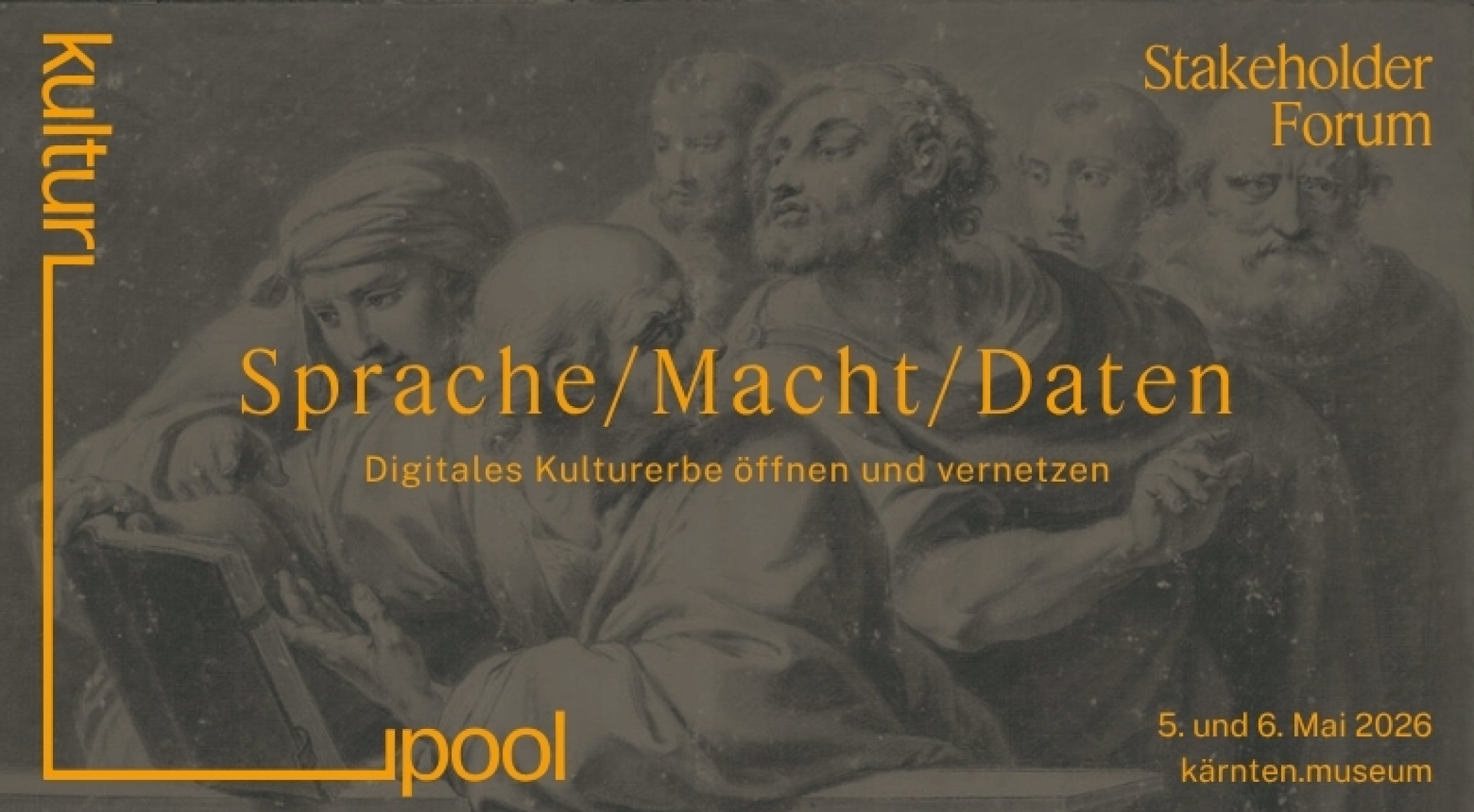
Event banner
NHM Wien, Kulturpool (Public Domain)
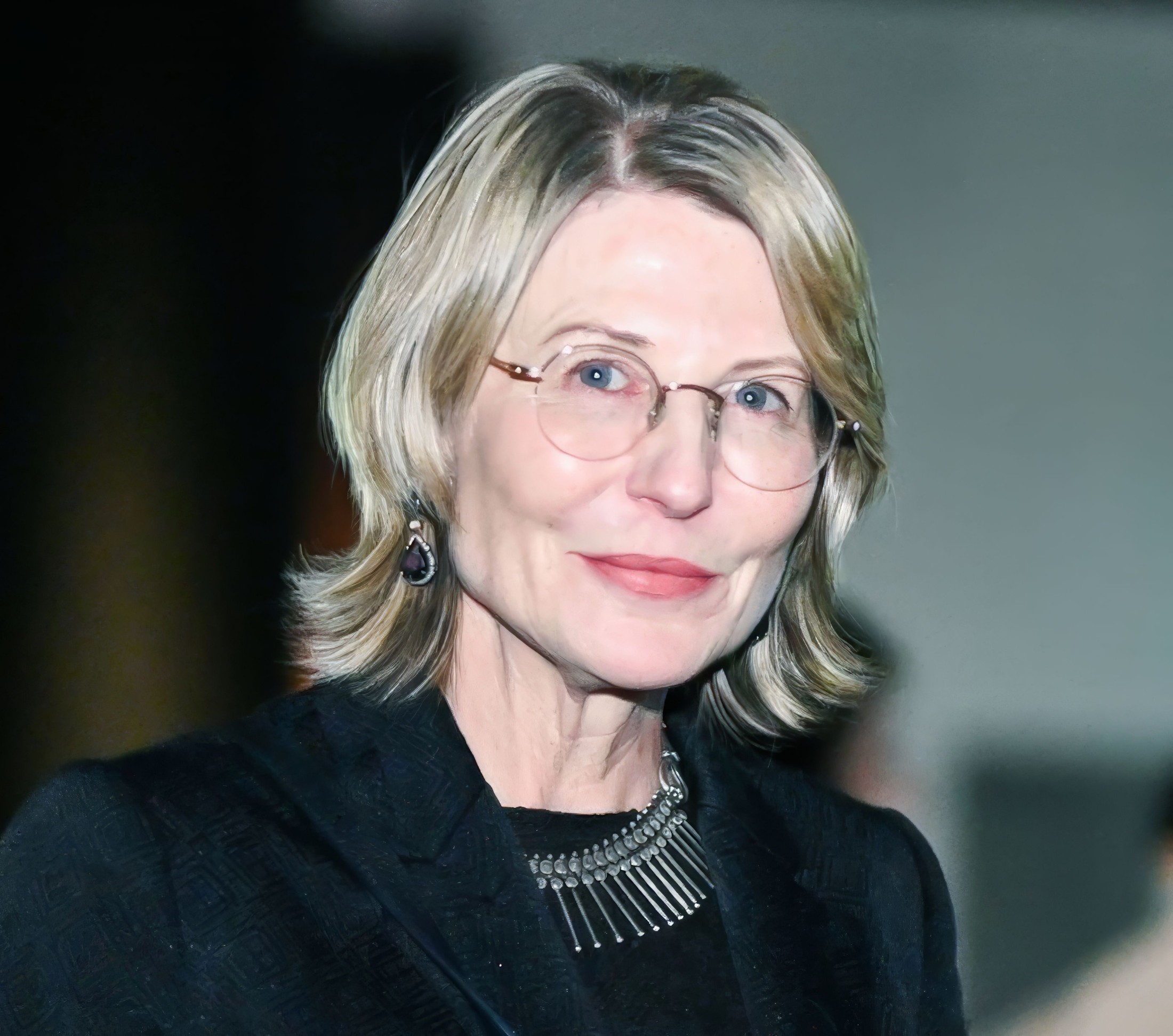
Sarah Kenderdine
© Sarah Kenderdine

